Why Can’t I Let Dead Dragons Lie?

let dead dragons lie

What I see anytime I see an old Japanese classic left to rot…

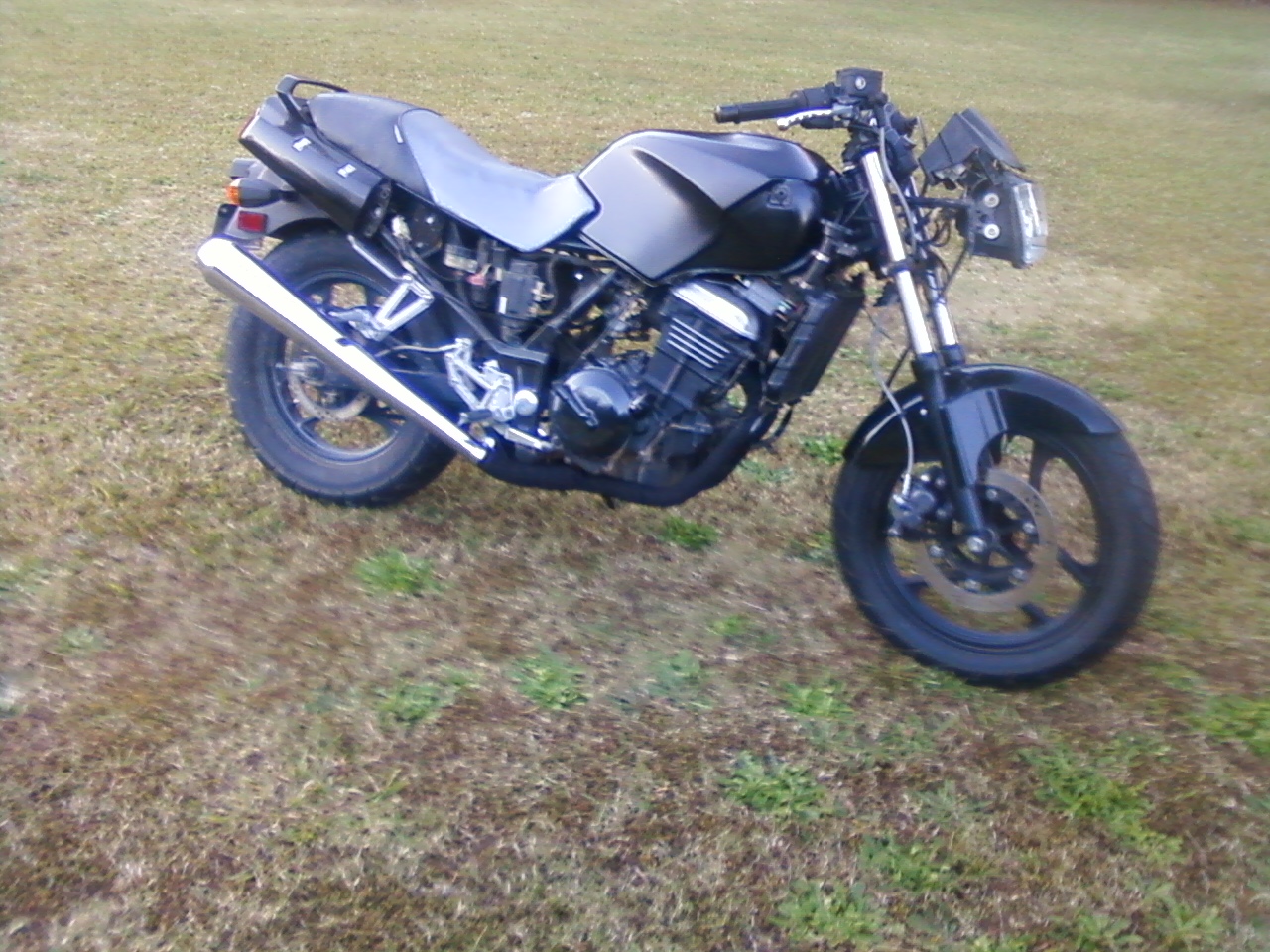
Here we go again, I knew this old Honda was bad news the first time I saw it. Years of abandonment & sitting out in the weather had taken a severe toll on every single piece of it, how often do you see a rust hole in the top of a gas tank?

<really messed up Honda Tank>

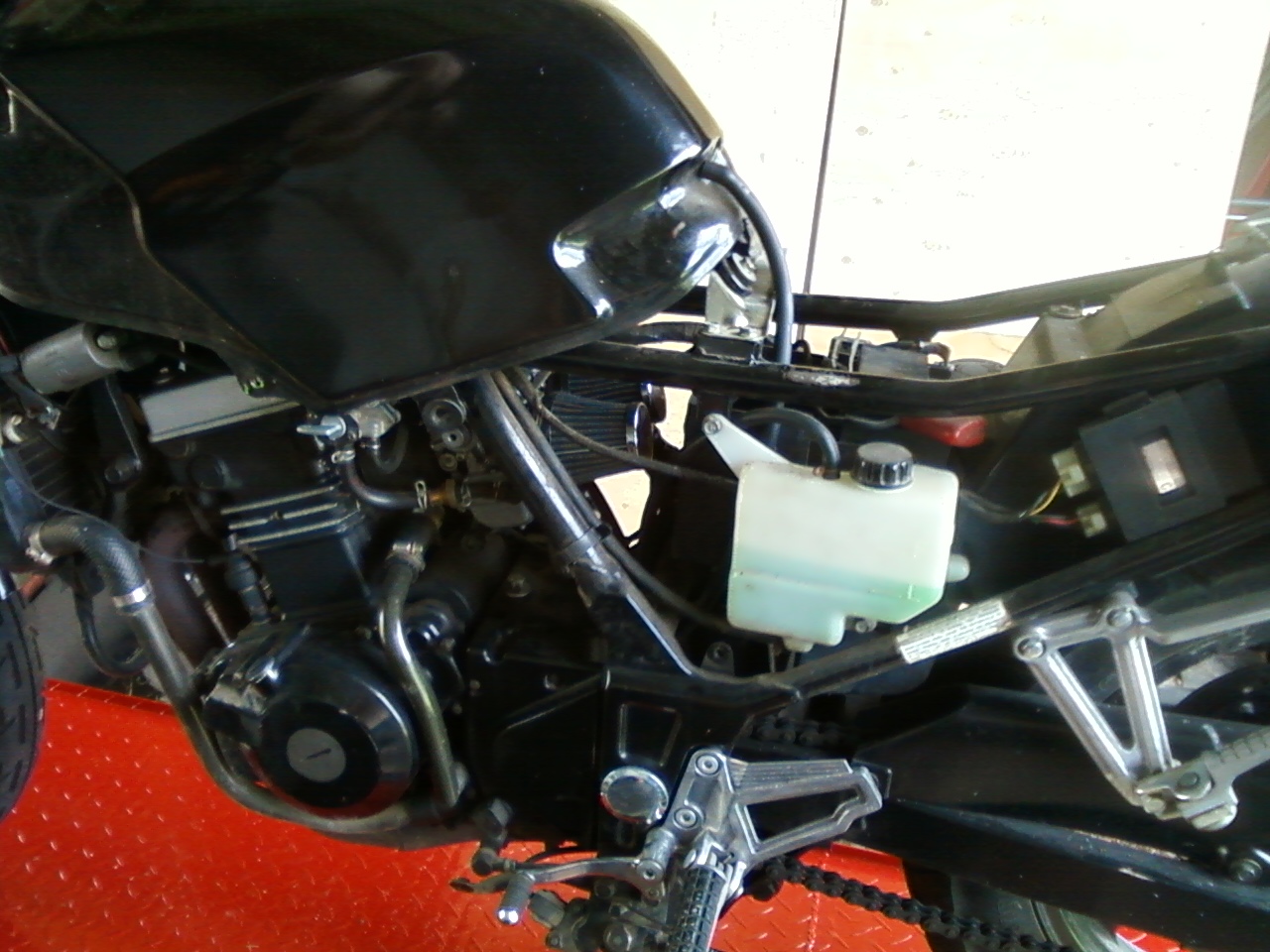
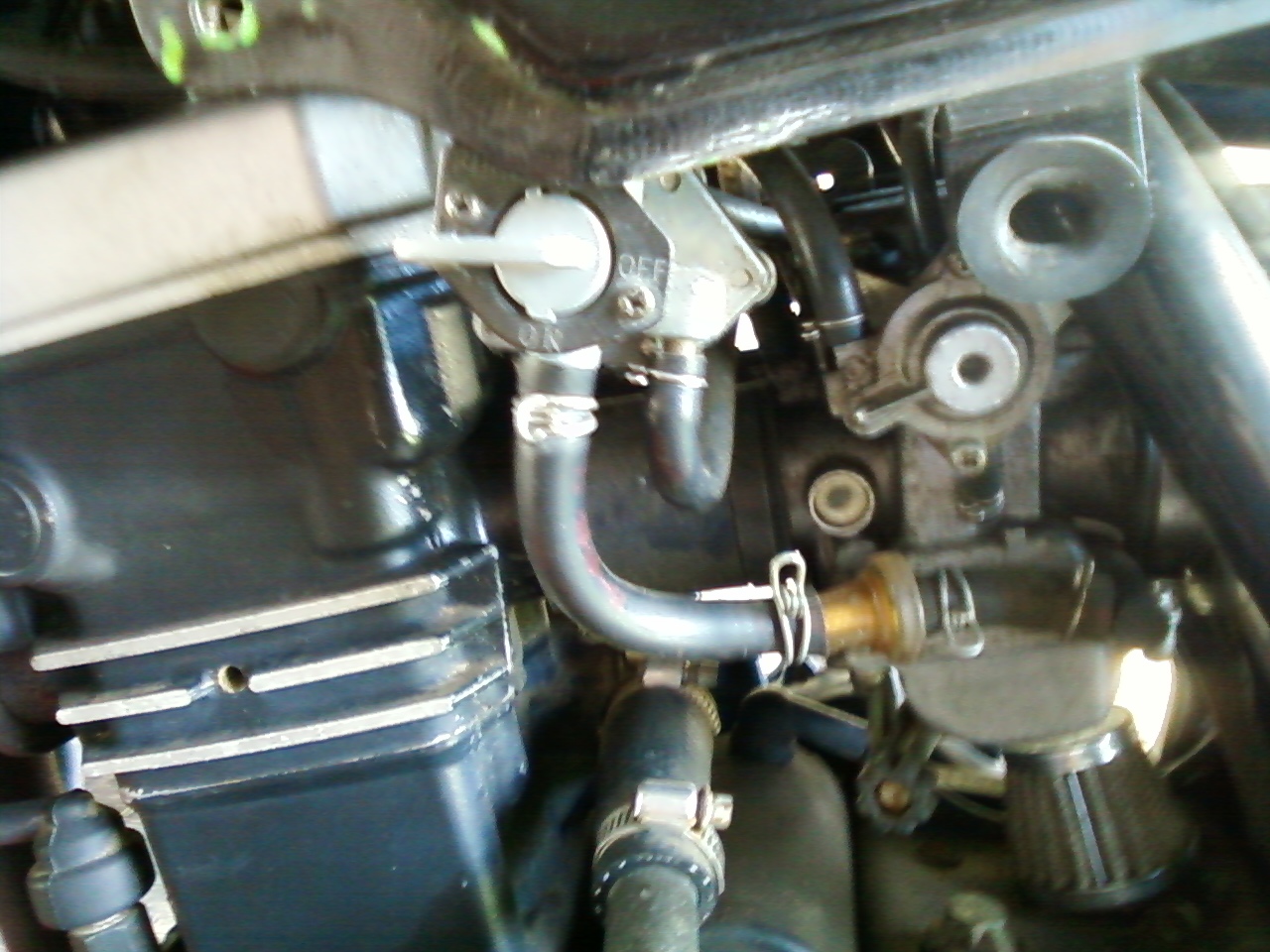
To make matters worse it is a 1980 model the first year Honda started using that sway backed horse looking frame designed to get the seat closer to the ground in hopes of getting more people into riding and thus increasing sales. And yet here it is sitting on my lift as I am evaluating its potential as a custom possibly a cafe racer. The S.C. inspection sticker on the fork is dated 1988, and this was probably the last time it was on the road as S.C. did away with inspections soon after. The carb float bowls were completely gummed up and one slide was frozen in its bore. But the residue cleaned out okay and corrosion was minimal leading me to suspect that it was pre-ethanol gasoline in the carburetors!. It actually fired up and ran after a fast & furious carb cleaning. Heck I even wire brushed the original spark plugs and stuck them back in as they all 4 spit great big blue sparks during my initial testing.

"<a

It actually was kind of anticlimactic, this ancient corroded cobweb covered corpse fired right up and ran like a Honda. I felt like some  necromancer in a fantasy story that had prepared a powerful magic spell to reanimate the dried bones of a dead dragon only to have it sit up, yawn and say, “well that was a nice little nap,” before I could cast my spell.

<1980 Honda CB650 4 SOHC>

It did smoke a little but there were no strange noises, not even a cam chain rattle. Since the engine is very rough looking cosmetically and I like to be as close to 100% sure about my motorcycles as possible,the next step in this evaluation is to pull the engine from the frame & take the head off and have a look inside. If all looks fixable I start renewing this bike in earnest beginning with an engine overhaul.

<CB 650 standard rear wire b4>

Although I try to kid myself that I am still evaluating this thing, I did purchase a set of wire wheels that I spotted on Ebay at a good price, & to crank it up I bought a new Shorai LFX battery for it. Experience tells me that I should wind up with around 3-4 thousand dollars in a motorcycle that might be worth 2 grand at the most. :O

Shorai LFX  the best motorcycle battery money can buy.

Shorai LFX the best motorcycle battery money can buy.

Help here I go again 🙂

Random Tech Tip, Vintage Carburetor Intake Boots & Clamps

Today’s post is about those annoying rubber boots that attach your carburetors to the spigots on the head(s).

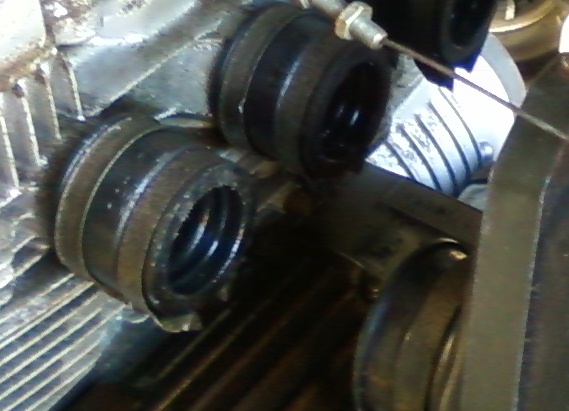
dry brittle old carb boots

dry brittle old carb boots

Often on old project bikes these are hardened and brittle, most of the time you can get the carbs out but it is almost impossible to get them back in. One thing that greatly helps is to take a heat gun and heat them up to soften them. Some people on the net have removed them and placed them in very hot water. Regardless of the method a small amount heat will help get them soft enough to reinstall the carbs. Just do not use an open flame or you will end up with a charred & useless mess. On some motorcycles these bolt to the head and on others they clamp to spigots cast into the head. If you are dealing with removal of old intake boots from a set of spigots like shown in the picture above prepare to be very patient. Don’t just grab a big screwdriver & start prying! First loosen & completely remove all of the clamps, then twist and pull them by hand until they will at least wiggle & turn on the spigots. If they still won’t come off you have to decide if it is worth the risk to pry them off. Choose your leverage points very carefully, if you have any doubt at all about being able to remove them safely or if you are working on a rare or valuable antique or classic machine this is where you break out a good sharp utility knife & cut them off. The cooling fins and other castings on most motorcycles are very thin and will often break before an old piece of dry rotted rubber will,so better to be safe than sorry.

intake manifold clamps

intake manifold clamps

Also be sure to look at the clamps when removing the boots. They are not just straight rubber hoses, often one end is bigger than the other, and the clamps are 2 different sizes as on this Honda CB650. The intake manifolds only fit one way but they have directional arrows on them, the clamps are not marked so be sure you note which ones go where.

That’s all for tonight, until next time have a fantastic life!

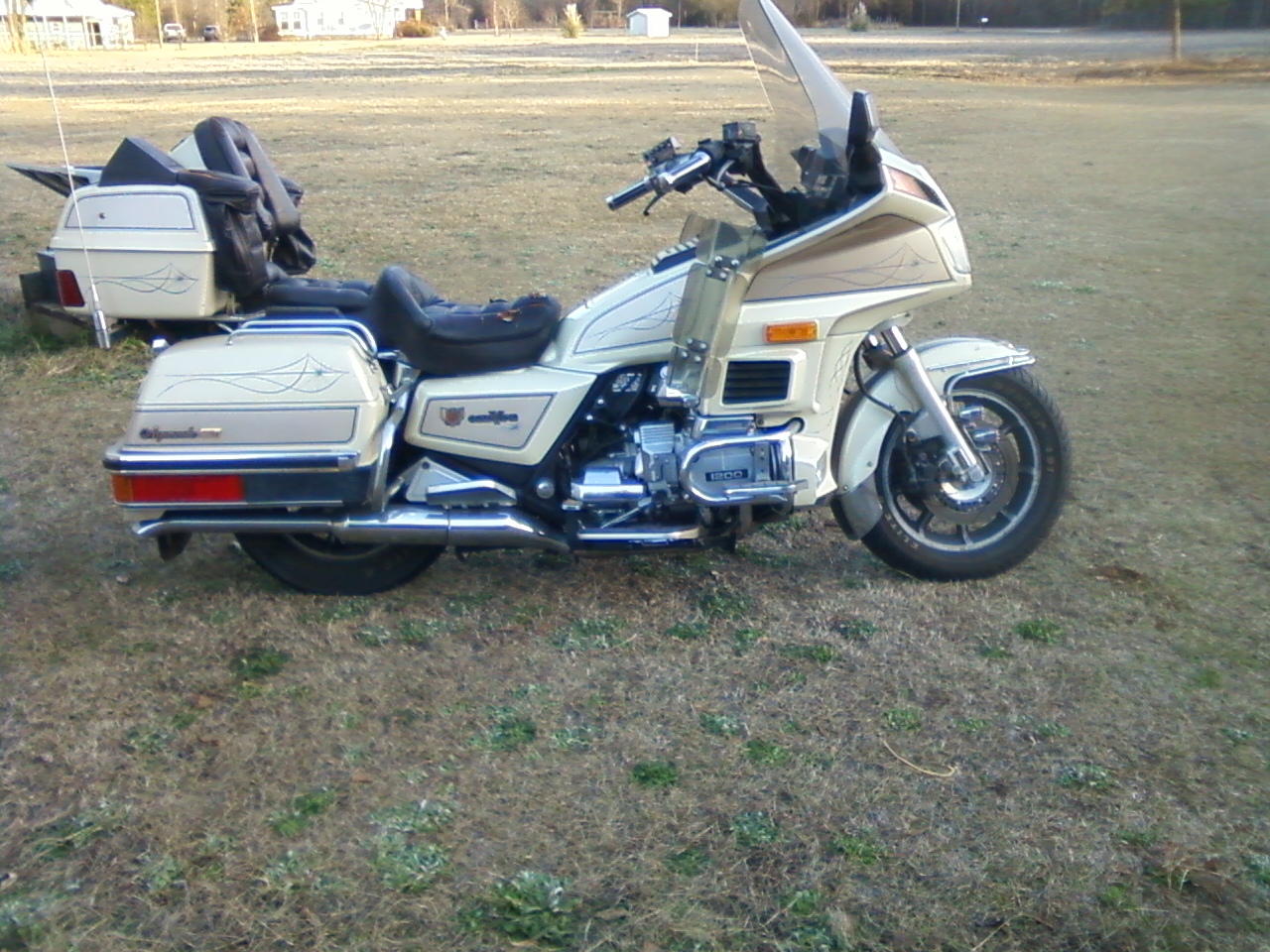
Cool Project Fuel Injectected 1200 Gold Wing

GL1200 GOLDWING SEI FRONT

GL1200 GOLDWING SEI FRONT

Had a long time client stop by today with a very interesting “bring it back from the dead” project. A mid 80’s Honda Gold Wing. And not just any old ‘Wing but the rare SEI model with computer controlled fuel injection. This should be interesting, hopefully it will be fun too, but it will definitely be interesting.

Gold Wing CFI cover

an old skool fuelie

It doesn’t look that bad but it hasn’t even been started for at least two years.

some neat old graphics

some neat old graphics

The owner also wants the seat height reduced a bit. Since the seat is trashed once I get it running the first thing to try is a custom seat. Then if he needs it lowered further it’ll be time to alter the suspension.

Gold Wing GL1200 SEI side

Gold Wing GL1200 SEI side

This one will take a while, stay tuned!

Changing the oill in your forks. (yes you should occasionally)

I’m going to cheat a little bit and just link to an excellent article over at Eric Peters Autos. In addition to doing automotive reviews and how to he has a great selection of motorcycle articles as well. This particular article that I am pointing out to you today is,        “Fork Oil Change How-To (and Why-To)” It’s informative and a good general guide for anyone who has never performed this often neglected prevenative maintenace on their own cycle. Enjoy!


EX 250 Ninja Basic Spark Plug & Oil Filter Change

Hello again everyone!

Welcome to another fun filled post on basic motorcycle maintenance. Today I am going to show you how I change the spark plugs and oil in my own personal motorcycle, a 1993 Kawasaki EX250 Ninja. While not exactly the same the procedure should be similar for other Kawasaki models such as the EX500 etc. To change the plugs requires removal of the seat & fuel tank at least. If your Ninja has the factory exhaust you can change the oil & filter without removing the exhaust system. Certain aftermarket pipes that run directly under the center of the engine will require you to remove the body work & the exhaust system just to change the oil. If you need a guide to removing the fairings & gas tank, please look here.

Before we get too far, let me go ahead and throw out a useful tech tip out for you. Most modern street bikes have the spark plugs buried down in deep holes in the center of the head(s). Combine this with compact frame design that often obstructs access to many parts of the engine and you can understand the need for long extensions to reach these parts with a socket & ratchet. The problem with this is that sometime the socket slips off of the end of the extension and remains trapped in the hole for you to fish out. Most of the time this is not a problem except with spark plug sockets that have the rubber grommet inside to hold the plug and the socket together. Those can be a royal pain in the ass if it gets stuck to the plug 6 to 8 inches deep in the head, when you pull the wrench away. Just to save some headaches any time I am working with a deeply recessed spark plug I use a locking extension such as the one shown in the picture below so that when I get ready to pull the socket out it doesn’t get left behind.
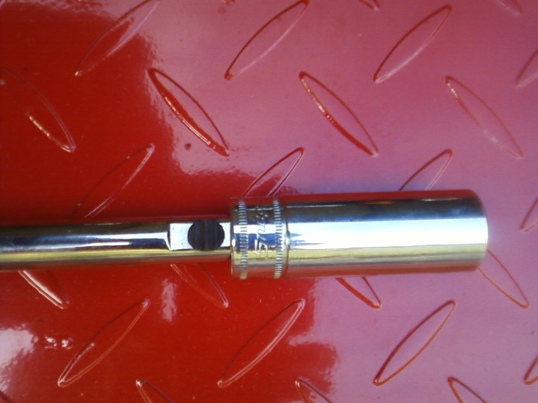
Snap On Socket on Locking Extension

spark plug socket on locking extension

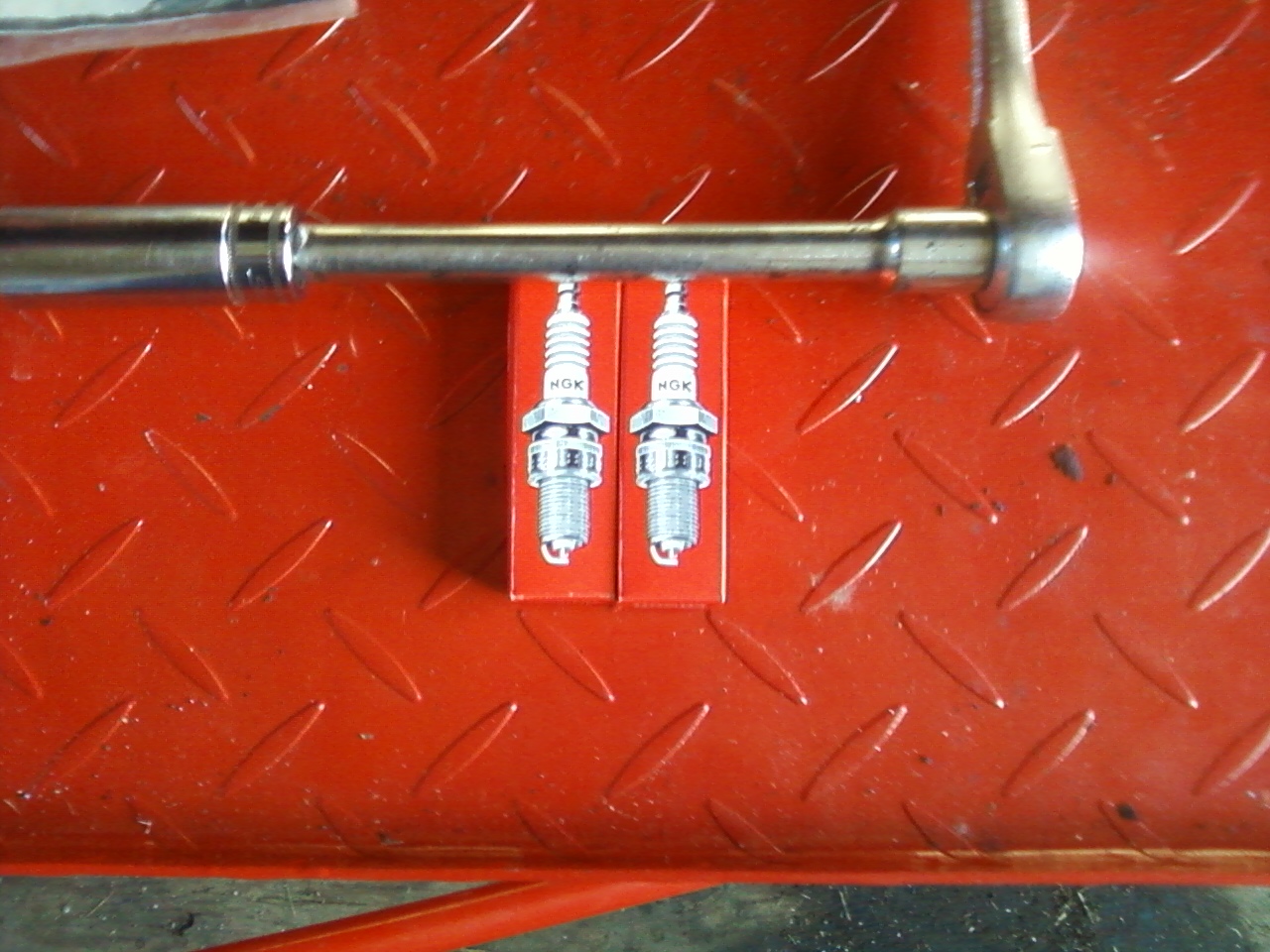
Consult your manual for your particular motorcycle and pick up a fresh set of the proper plugs for your motorcycle. Please be aware that some manufacturers will list plugs as interchangeable for motorcycles and these plugs will screw right in, but are of absolutely the wrong heat range to work properly. The result of this is a very short plug life with possible engine damage. For the Japanese, British, & most European brands I try to stick with NGK & Nippondenso brands, but have also used Autolite successfully as well also. The important thing is to get both the correct size & heat range for your engine.

fresh new NGK spark plugs

fresh new NGK spark plugs

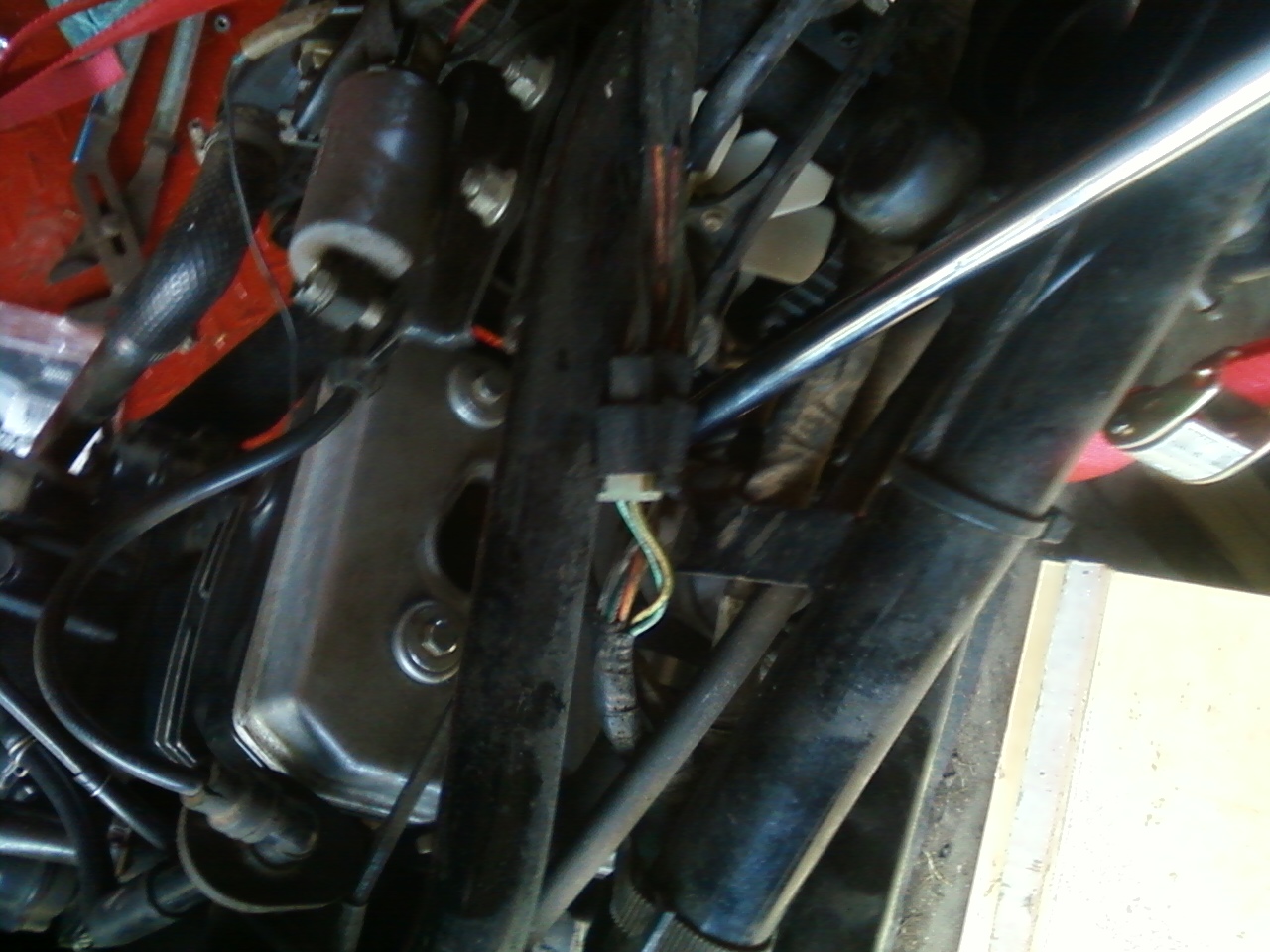
Once you get all of the body work off, pull the plug wires loose and either vacuum or blow out the holes with compressed air. Then using a long extension put the spark plug socket into the hole(s) and unscrew the plugs. If you are using a spark plug socket they should come out with the socket. If using a regular socket you may have to use a magnet to remove the plugs from the holes. Looking at the next couple of picture should show you why I am a fan of locking extensions for this job.
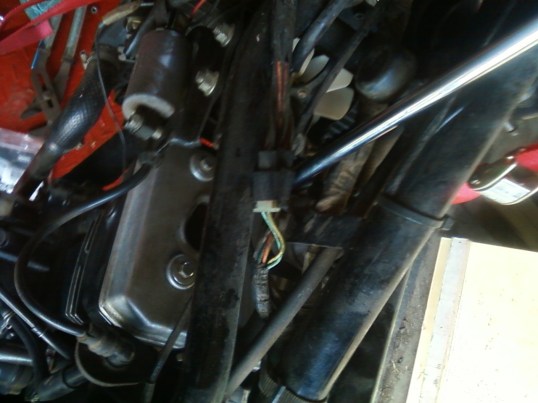
how a spark plug wrench fits a Ninja 250

how a spark plug wrench fits a Ninja 250

Next take your new plugs and inspect the gap between the electrodes. Spark plugs today come pre-gapped and protectively packaged but it is till a good idea to at least check the new plugs for damage such as electrodes pushed together, or cracks in the insulation. Place a plug securely into the socket so that it wont fall out and insert it into the plug hole taking care not to hit the end of  the plug on anything and close up the gap (this will keep it from working). You should be able to start the threads and screw the plugs 80% of the way into the heads by hand with no problems, and then finish them up with the ratchet.  Most of these heads are aluminum, so take great care not to cross thread them or strip the holes out, because the repairs for that are expensive & difficult. I never use more than one hand to tighten them and even then I don’t use full force. Now for the disclaimer part; You should always follow the manufacturers recommended torque settings. Unless you are an experienced wrench turner you should buy a torque wrench and use it. Even if you are an experienced wrench but are prone to screwing up every now & then you should use a torque wrench too. There is absolutely no way for me to teach you how tight is just tight enough. Not even if you were standing here next to me.
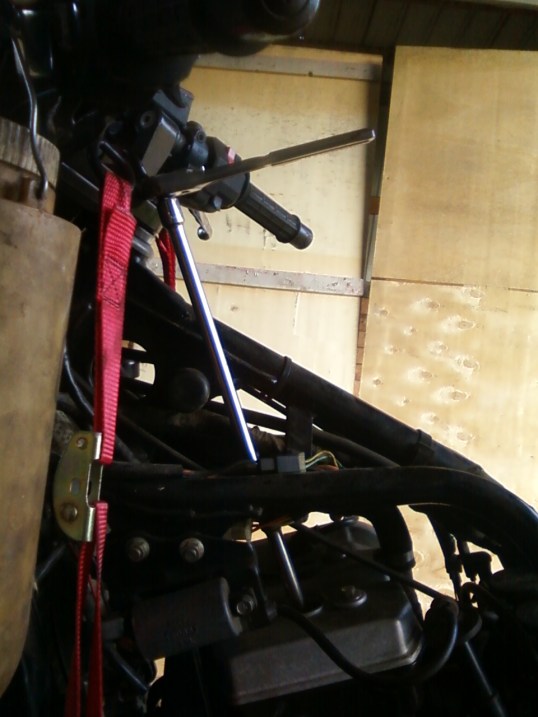
long extensions make life better

using a long extension to reach down into the plug recess

After you get the plugs in put the wires back on securely, put any parts back that you had to remove to get to them, then re-install the tank and seat. Start the engine and if everything sounds okay take it for a test ride. If you have any problems that you didn’t have before retrace your steps until you find what went wrong. If you were having a problem before changing the plugs and you have the same problem afterward something else is probably wrong.
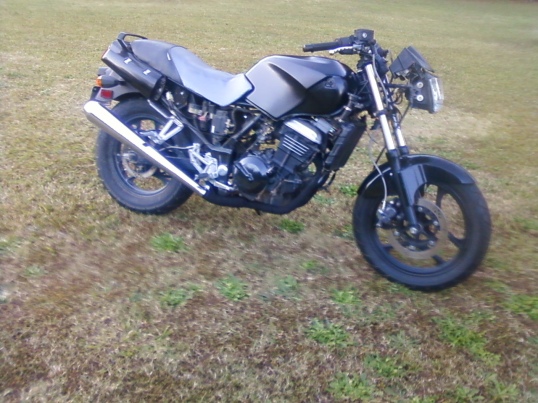
Test Ride Time

go for a test ride before putting all the bodywork back on

Since I already had all of the bodywork off of this one I took it for a test drive just like this.

Time to change the oil

Locate the oil drain plug
ninja 250 drain plug location

ninja 250 drain plug location seen from above

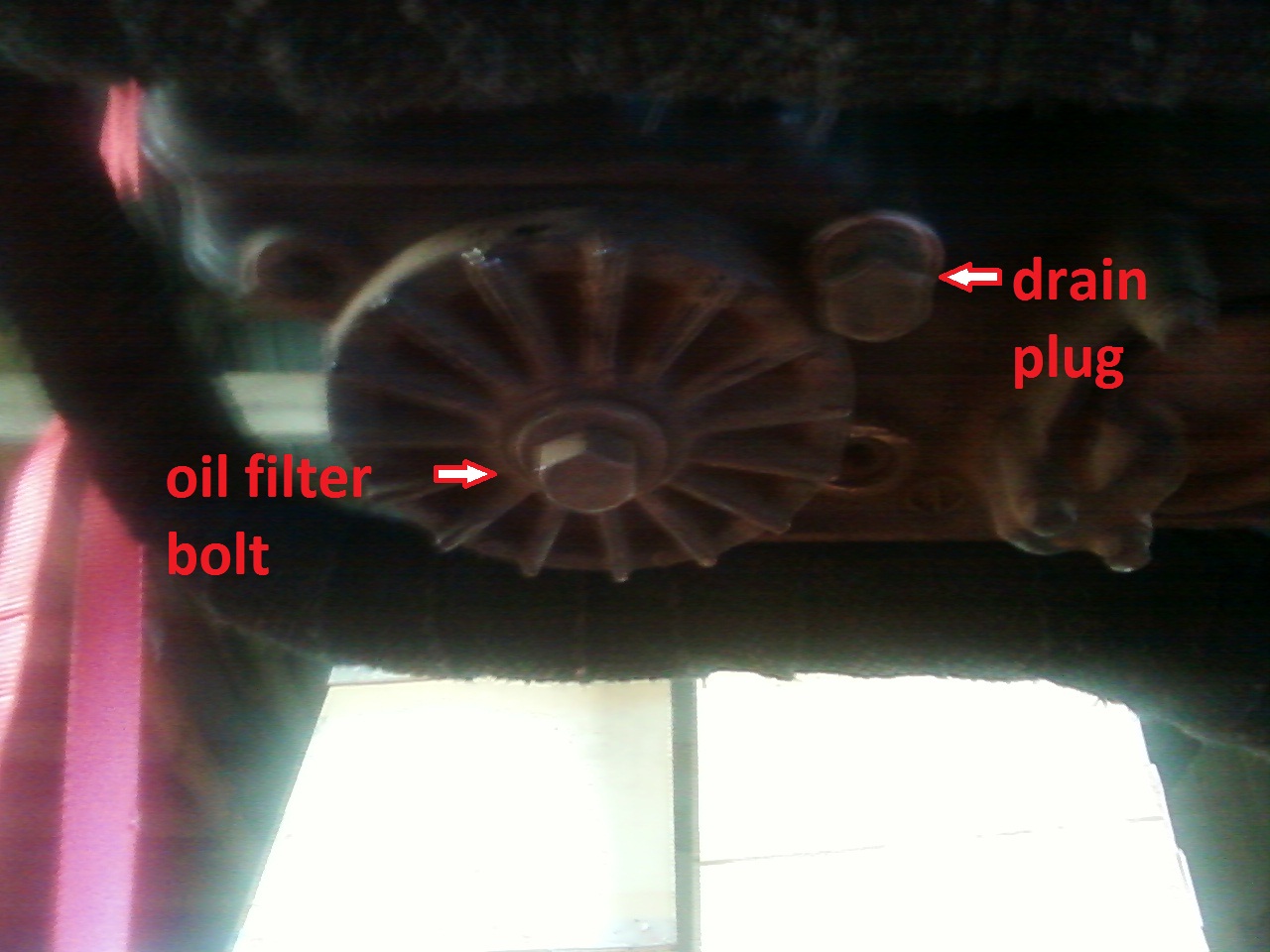
Here’s a better shot of the oil drain plug & filter bolt. The 250 Ninja, like a lot of older motorcycles uses an internal cartridge oil filter instead of a spin on filter.
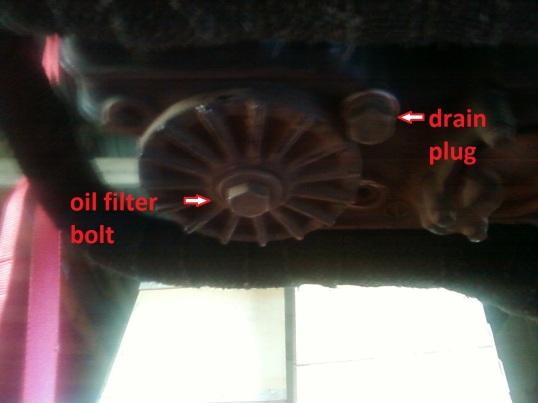
ninja oil filter & drain plug location

ninja oil filter & drain plug location

Place a container under the drain plug an remove it to let the oil drain out.
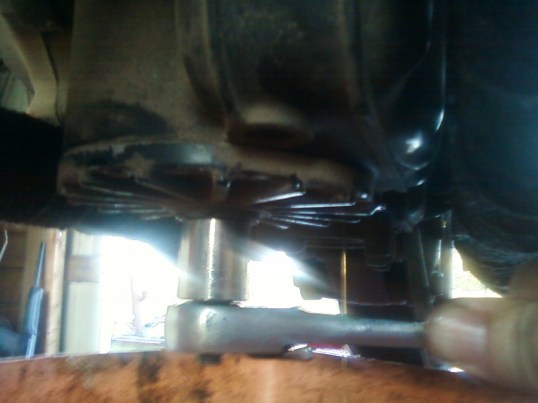
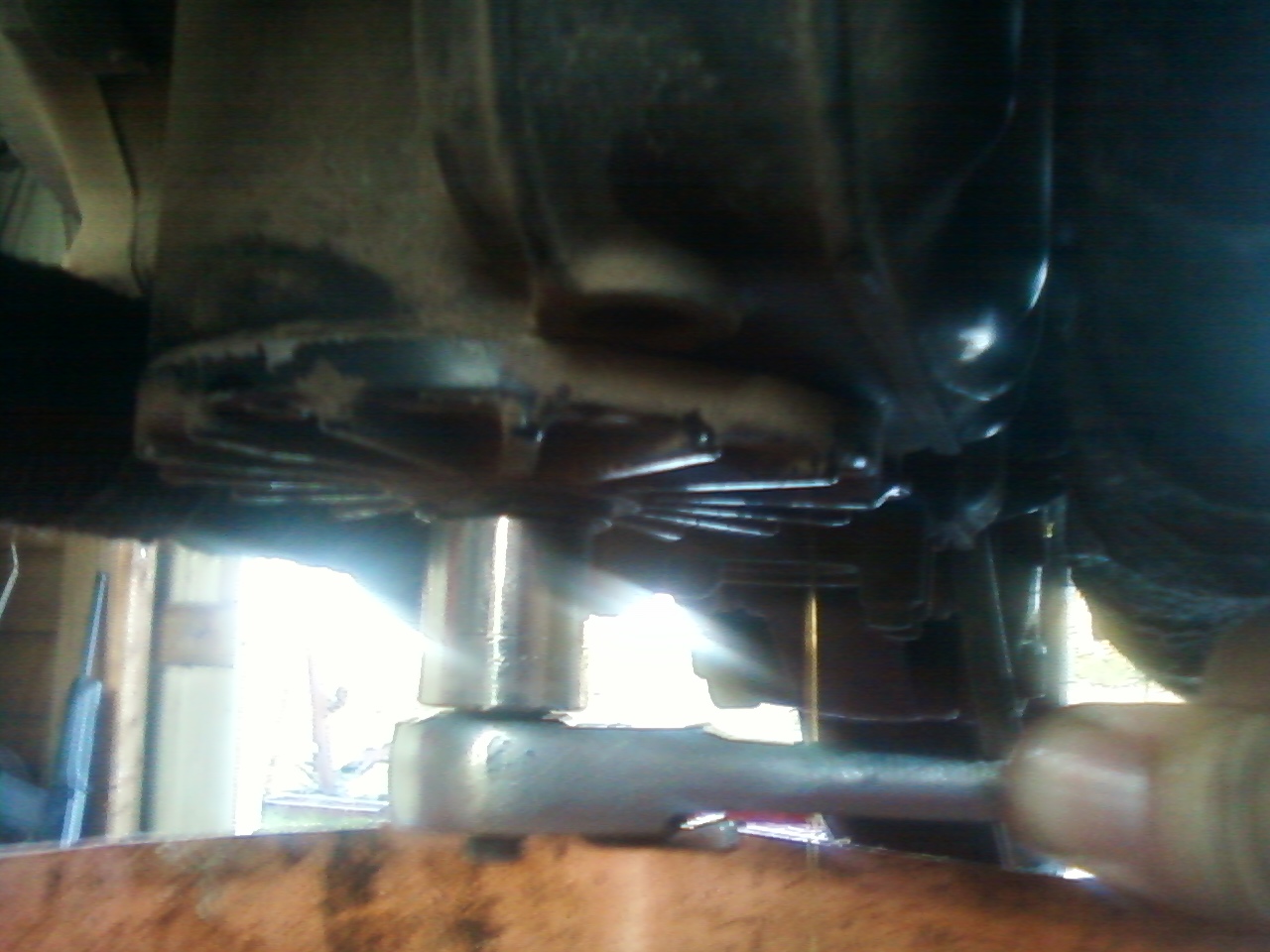
wrench on ninja oil filter bolt

wrench on ninja oil filter bolt

Then put your wrench on the oil filter bolt and unscrew it. When you get it loose a lot of oil may come out around it so stop a few seconds & let it finish draining and then completely remove it from the bike.
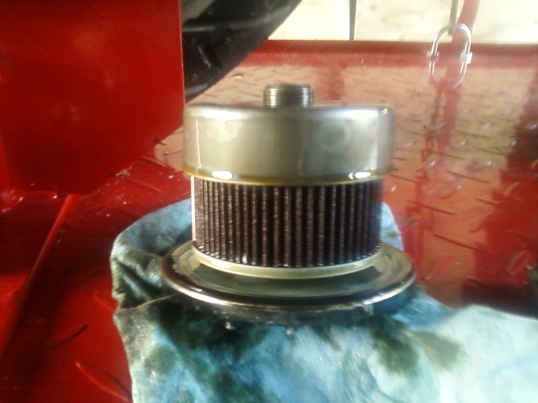
dirty oil filter ex250 ninja

Here’s how the filter looks when it comes out.

Pull the assembly apart taking note of how all of the parts fit together discard the old oil filter in an ecologically responsible fashion and thoroughly clean & inspect all of the other parts. If your new oil filter came with new o-rings then use the new ones. If it did not (& some brands don’t) carefully inspect your old ones & if there is any doubt about their condition get new ones before going any further. After all nothing will ruin your day as fast as a nice slippery rear tire coated with motor oil.
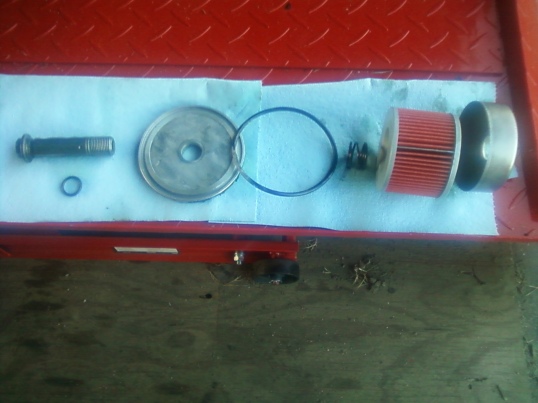
exploded view 250 Ninja oil filter assembly

exploded view of 250 Ninja oil filter assembly

Put all of the parts of the oil filter back together & re install it into the engine. Next check the aluminum sealing washer on the drain plug & replace it if needed, before re-installing the drain plug.
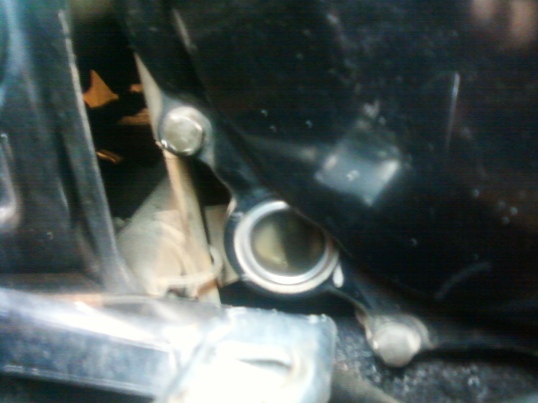
93 Ninja oil level sight glass

93 Ninja 250 oil level sight glass

Locate the sight glass on the lower right hand side of the engine.

the oil filler cap

the oil filler cap

Then remove the filler cap, place a clean funnel in the hole and with the motorcycle  straight up either on the center-stand or workbench or held up by a friend pour oil slowly into the engine until the oil reaches the top of the sight glass. Replace the filler cap.
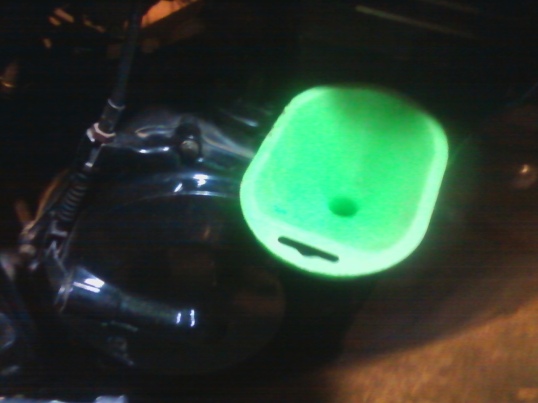
always use a clean funnel

always use a clean funnel

Then start the engine for a few seconds, watch for leaks as you do and then shut it off. Now with the motorcycle still perpendicular to the ground check the oil again. You will probably not be able to see any oil in the sight glass at this point so remove the filler cap and add oil until it is at least halfway up the sight glass but not over the top of it. After doing this replace the filler cap & start the engine again and let it run a few minutes while you check for oil leaks.
proper oil level in motorcycle sight glass

proper oil level in Ninja 250 sight glass

After you stop the engine again check the oil level one more time just to be safe. After all a an EX250 only holds a couple of quarts so you really don’t want to be a half a quart low. Now get to riding!

Peace Y’all
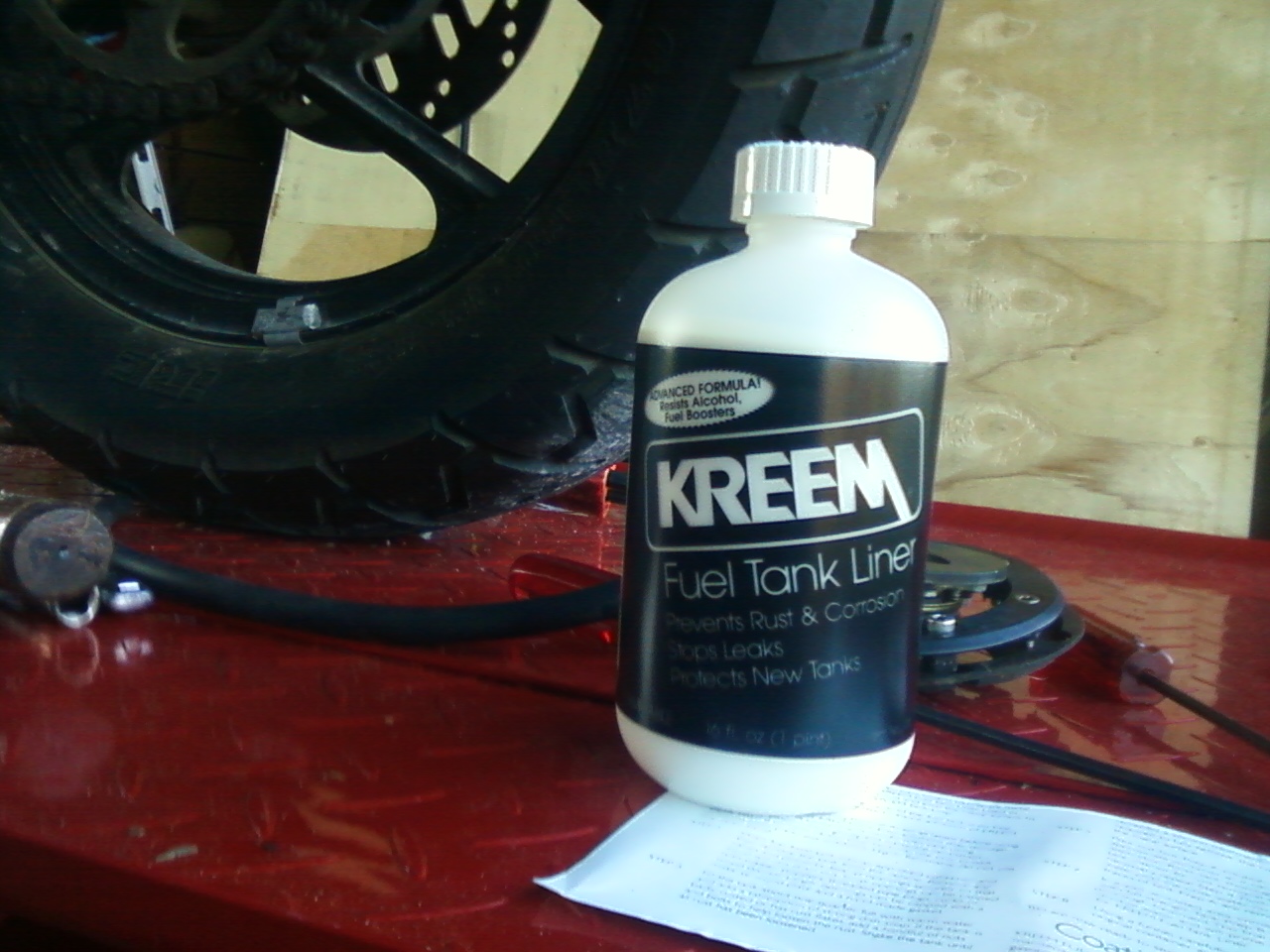
Lining a Fuel Tank with Kreem Tank Liner

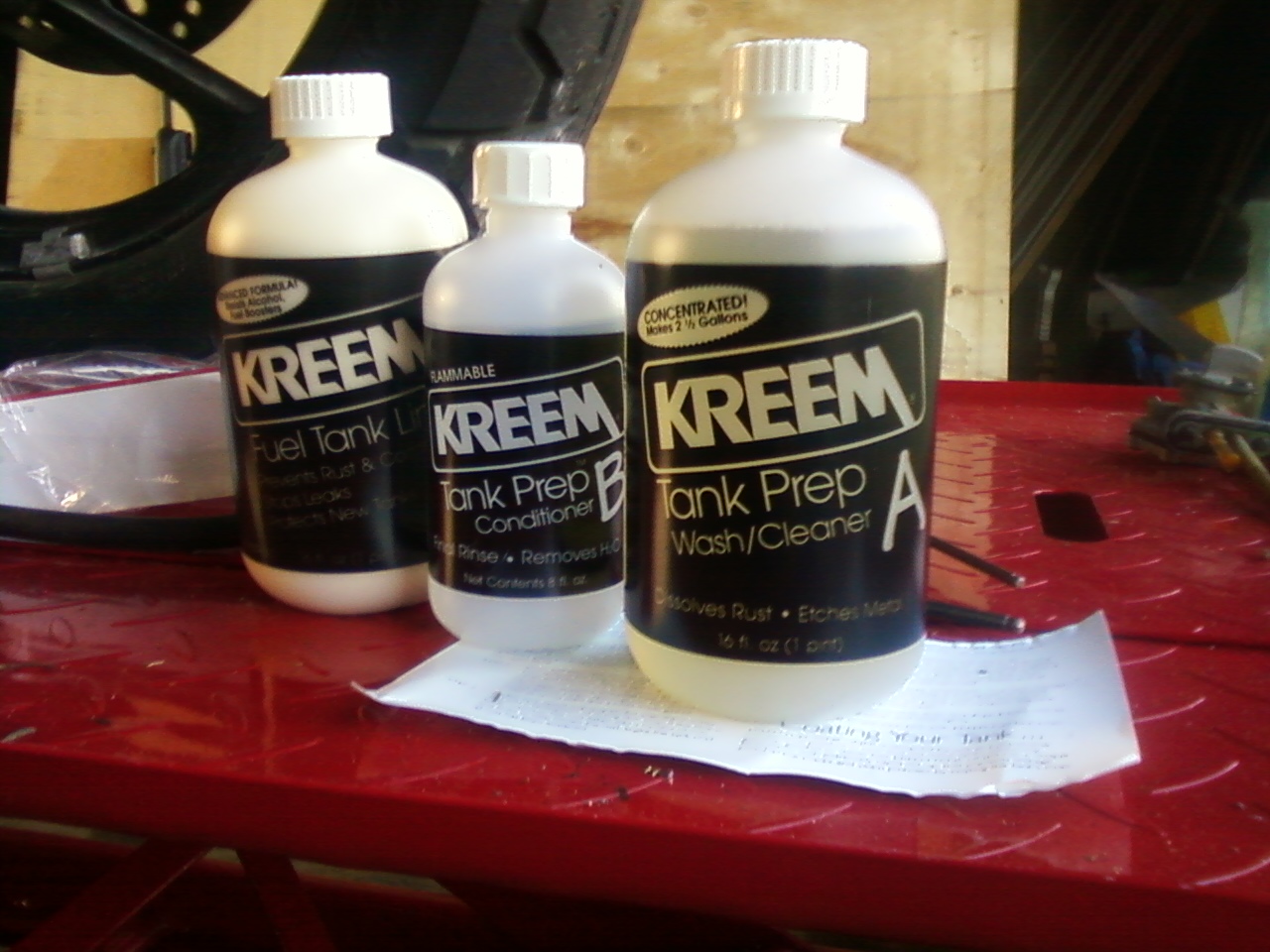
Kreem tank liner kit

Kreem tank liner kit

This is sort of a combo how to and product review. I will admit that my review is a little biased because I have been using this product for over 20 years and have always been satisfied with the results. I wont repeat the instructions word for word but I will give you a few tips to help you get better results. First empty your tank and remove the petcock and filler cap if it is bolted to the tank.

Remove the Kawasaki locking fuel cap

Remove the Ninja’s locking fuel cap

The next step is critical to getting good results especially if working with the tank from a 2 stroke engine. You must completely degrease the inside of the tank with a good industrial degreaser. Do not use dish liquid because it often contains oils to protect skin. Be prepared to wash it more than twice if needed to get the oil out.

Wash & degrease tank thougoughly

Wash & degrease tank thoroughly

Now open up the kit and get out the bottle labeled “A” wash & cleaner. Use duct tape or a blocking plate to block all of the holes in the bottom of your tank. I like to use a piece of metalized tape first and then cover it with duct tape.

Kreem Kit Part A

Kreem Kit Part A Use proper precautions for mild acid.

The instructions say to use warm water and I agree it does help the acid work much faster. Please note the standard kit shown here is for smaller tanks. Normally for a 5 gallon tank like this I would buy the larger size, but I had some left over from a previously restored tank, that I added in after using this up according to the instructions. The cleaner part A can be saved and re-used a time or two.

Warm water is reccomended to mix with cleaner

Warm water is recommended to mix with cleaner

After the tank is full seal off the top and let it sit for at least the minimum time given in the instructions. Since this was an old tank with some rust inside I let it sit overnight. At this stage some people will put in rocks or nuts & bolts and shake the tank to help remove thick rust. If you need to do this I recommend that you use steel nuts & bolts so that you can retrieve them easily with a magnet. Some fuel tank designs make it difficult to remove rocks after you are finished cleaning out the rust.

Next remove all tape from the openings rinse the tank well until the water comes out clean. and then thoroughly dry the tank on the inside. Since I had plenty of time I placed the tank in a hot sunny location to air dry. In the winter time or if you are in a hurry use a hair dryer or a hot air gun to speed up the process.

<ninja fuel tank drying in the sun>

fuel tank drying in the sun

I do need to warn you about one thing if you are trying to fix a tank with a nice paint job or if you are coating a new tank as a preventative measure you want to be very careful with this stuff, especially in the next two steps.

Seal up all the holes again and get out part “B” the conditioner. This bottle contains MEK which can remove paint faster than tequila removes panties. If you have a nice paint job & spill this on it, you wont have a nice paint job anymore, so be careful. I am re-painting this tank so I don’t really care if I spill some. After sealing the tank back up shake all around the inside of the tank & the carefully drain it out protecting your paint as needed.

Kreem Part B final rinse

This is highly flammable & can destroy paint so be careful.

Since the petcock on this one bolts into place before going to the next step I put two screws in the bolt holes to keep the threads clear. To me this is just much easier than cleaning out the holes afterward.

petcock screw holes

I like to put bolts in these holes to keep them clear

Now you are ready for the bottle of fuel tank liner. All the same warnings about paint damage apply to this bottle as well.

Kreem Part C liner

Kreem Part C liner

Here is a shot of how I use the metal tape first & then cover it with duct tape to seal the openings in the tank. It works well for me, but I make no garuntee that it will work this well for everyone.

<handymans best friend>

Red Green is absolutely right about this stuff! (Duct tape that is)

Then pour in the whole bottle of liner, and then seal up the filler hole as I did in the next picture.

pour in Kreem Tank Liner

pour in Kreem Tank Liner

then seal up the filler hole

then seal up the filler hole with duct tape

Then spend the next 30 minutes or so slowly rotating the tank end over end and sideways until you are 100% certain that the entire inside of the tank has been covered with sealant. Next (and this is very important) open the tank back up and drain the excess sealant back into its original bottle. Do not leave it in the tank as it will greatly increase drying time. If too thick it may skin over on the top and take nearly forever to dry all the way through, causing you to have problems later. I usually save the excess to use on the next project. I am usually able to do a lawnmower tank or two with the leftovers.

Like I said if you follow the instructions in the kit and the hints that I gave here you should be able to tackle this job yourself at home. Just give yourself a couple of days if your tank is rusty, and be sure you drain the excess sealant out of the tank and give it time to dry really well. This stuff aint cheap at approximately $50 a pop (November 2012 price) so you want it to work right the first time. I have used other tank sealers with varying degrees of success, but I always come back to the original Kreem brand. Plus it is usually in stock on the shelves in most motorcycle dealerships. Besides have you priced a new gas tank lately? It’ll give you a coronary!

Peace Y’all

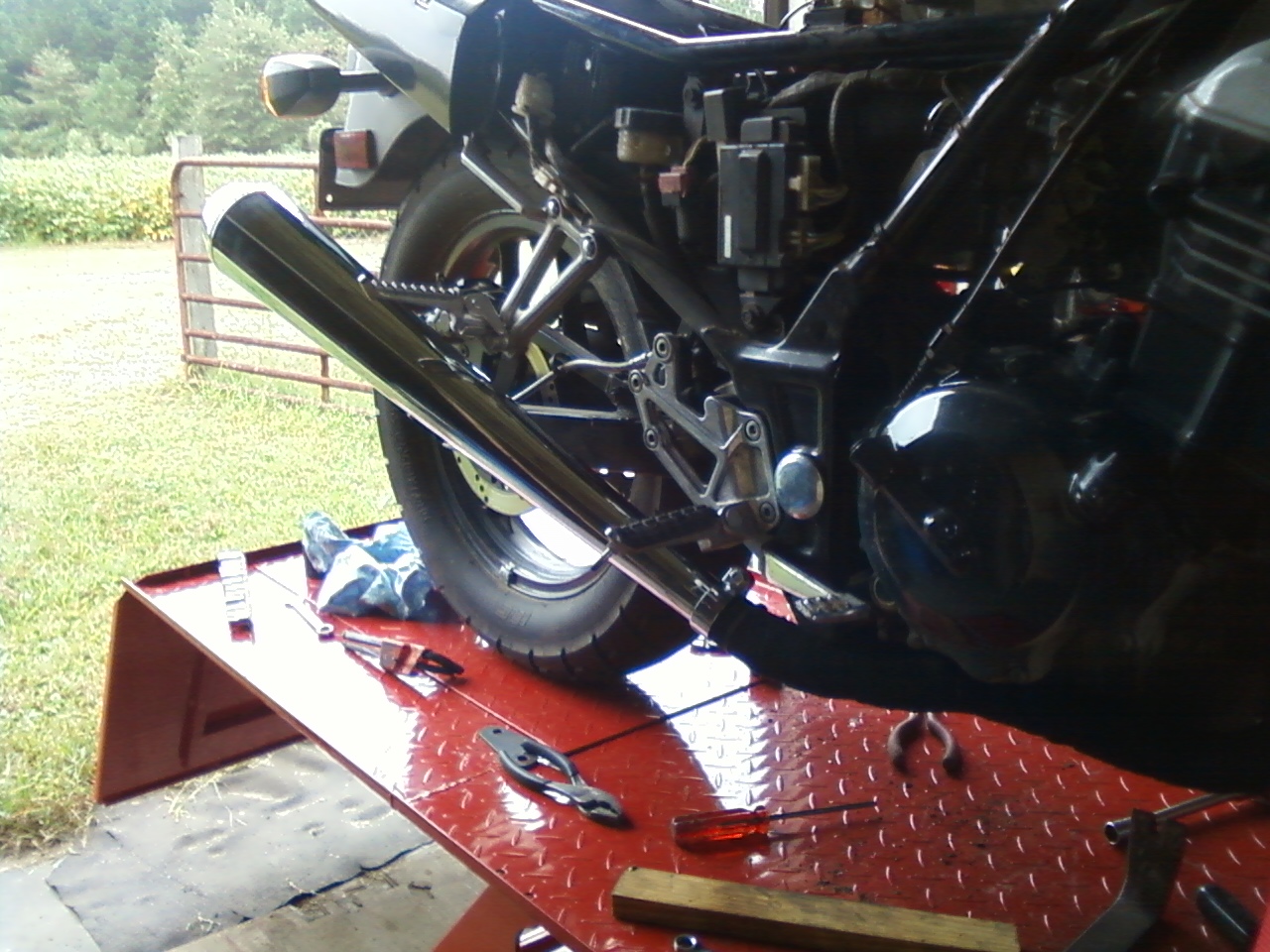
Installing Dunstall Replica Mufflers on an EX250 Ninja

When I last posted about my work on the Minimum Ninja, you saw a photo of a damaged and worn out aftermarket exhaust header. When my wife bought this as an abandoned bike from the back lot of a Kawasaki dealer for a c-note a few years ago, it had the Yoshi pipe on it, so I had to  buy a stock head pipe. If your Ninja has the stock mufflers you don’t have to do all of this work, just figure out where to cut them off, put the right adapters in the new muffler, make some brackets and go. Not being that fortunate I had to do a little more work, not a problem for me tinkering on a motorcycle is as much fun as riding one. I started with a piece of 1 1/4″ water pipe,way bigger than the exhaust pipe but a good enough match to the size of the flange around the pipe to be easy to weld.

1 1/4 inch water pipe nipple

So I stuck it in my handy dandy pipe bender and bent it to the desired angle. Please note that pipe benders like this will NOT bend thin wall tubing without crushing it, they are meant to bend schedule 40 steel pipe or very thick walled DOM tubing.

An inexpensive pipe bender

After bending and cutting it to the right length grind one down enough to slip into the new muffler. And absolutely grind away all of the galvanizing from the area to be welded. The fumes given of by burning galvanizing are very dangerous. Use all necessary precautions. I would have used black pipe but the hardware store was closed and Lowes did not carry it in this size.

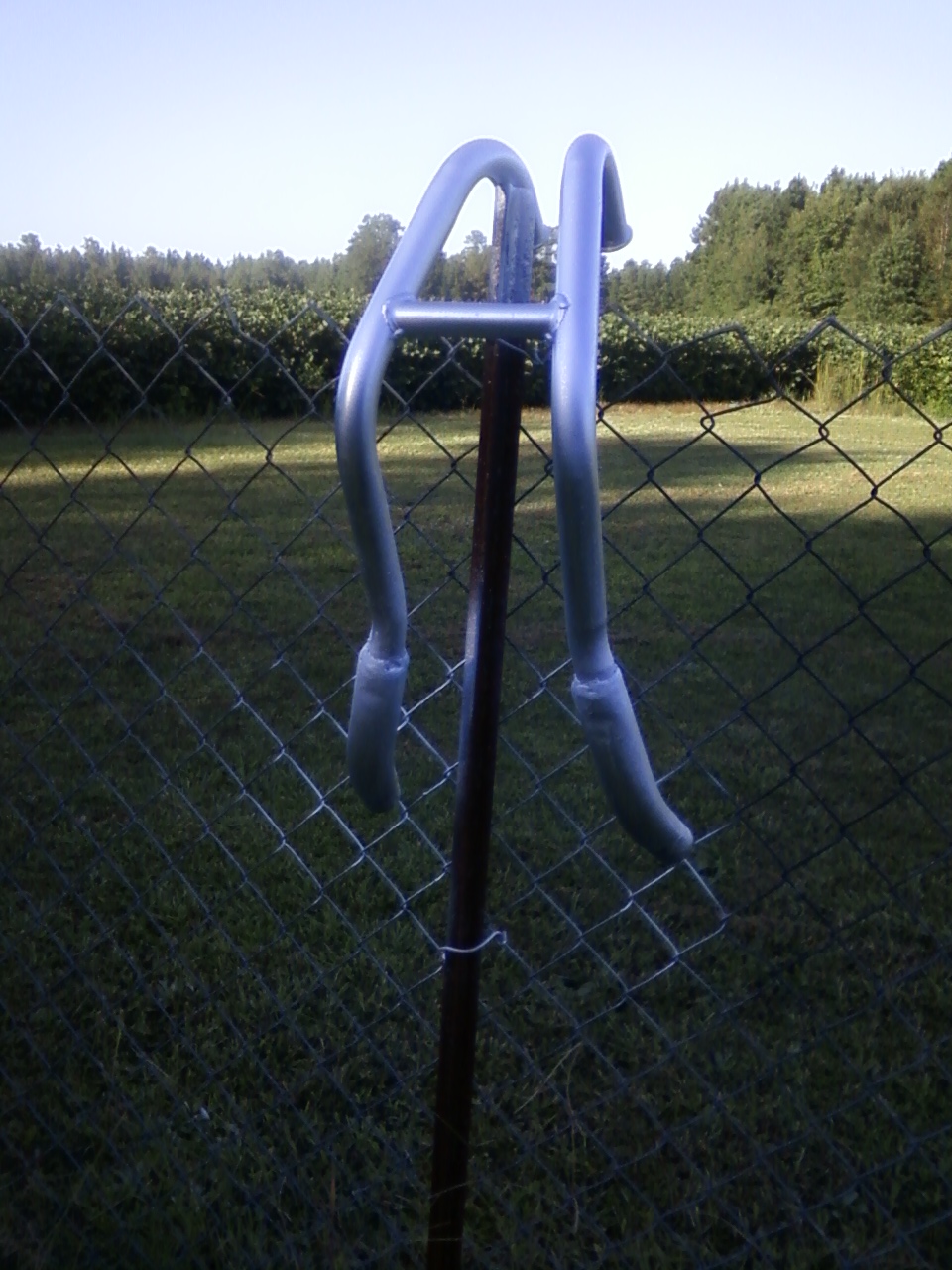
home made muffler adapter

one is done and one more to go

Then I mocked it all up on the bike and tack welded the adapters to the head pipes.

Ninja Dunstall muffler adapter mockup

Mocked up for tack weld

After that I pulled everything back off and seal welded the pipes together, cleaned off the scale and shot the pipes with a coat of high heat paint

tack welding completed

tack welding completed

pipes seal welded & painted

pipes seal welded & painted

Then I wrapped the entire head pipe with header wrap and reinstalled everything.

Head pipe wrapped with 2" wide fiberglass wrap

Head pipe wrapped with 2″ wide fiberglass wrap

I did take the centerstand off, 😦 it just did not work with the new pipes. Besides now I have a motorcycle lift table when I need to work on it now.

Next time I’ll show you how I lined the fuel tank with tank Kreem. An oil & plug change how to is in the works too.

Peace Y’all

 fiberglass header wrap

P.S. This thing sounds really good now and is not nearly as loud as it was.

Strip the Bodywork from a Ninja (93 EX250)

Here I’m just going to let you follow along as I remove the fairings, fuel tank, and exhaust system from my 93 Kawasaki 250 Ninja. Although the title of this blog is Life on Two Wheels, the truth of the matter is that for last year & over half of this year a true story of my life would have been called life in hotel rooms and rental cars. While I was away I still managed to squeeze in some bicycling time, and I did try on the occasional weekend to take my motorcycle out for a spin but unfortunately never far or often enough, and it has developed some problems related to long term storage anyway. A couple of months ago I started a new job, moved back home and now am ready to get back down to the business of serious recreational motorcycling again.

1993 Kawasaki Ninja EX250

’93 Ninja 250 Fresh out of the shop after restoration 4 years ago!

This bike still starts right up and once warmed up will zip from idle to redline with just a flick of the wrist, riding it at low speed or for a short distance no symptoms are discernible. If driven at highway speed for more than 3 or 4 miles it begins to spit and sputter and stops like it has run out of gas. So far I have done all of the easy and obvious things such as verify the gas cap & other fuel tank vents, made sure the fuel petcock was working, and that both the in tank and external fuel filters were clean. So now its time to pull the carbs back off and check everything out. Since I am tired of having to pull the exhaust system off every time I want to change the oil filter (and it got some holes in it now also), I am going to pull the Yoshimura 2 into 1 header and replace it with a pair of Emgo Dunstall replicas using some custom fabricated adapters welded to the end of some factory head pipes.

As you are following along please be aware that my cycle is not stock. It has a few aftermarket, modified or bespoke parts on it so even if you have the same make and model of motorcycle you may notice many substantial differences between mine and yours. Just remember modifications to your motorcycle are made at your own risk, some may be dangerous or illegal in some places, I am not a motorcycle engineer, nor do I play one on t.v. Use your best judgement,consult your doctor, shrink, & attorney, then get a permission slip from your mom before imitating any mods you see on this site, because I am only responsible for my own stupidity, not yours. Now that the disclaimers are out of the way , let’s get to work!

First pull the mirrors.

Ninja 250 mirror removal

Ninja 250 mirror removal

Unbolt the lower fairing I like to start with the front center bolt first.

Ninja 250 lower fairing remove bolt

Ninja 250 lower fairing remove bolt

Ninja 250 lower fairing removal

Additional screws indicated by arrows.

Time to get the upper fairing loose You will notice some very blotchy spots in the next photo. It is not paint damage. I discovered the hard way that if you are shall we say a larger boy, you should not take pictures of shiny very reflective surfaces while wearing nothing but a pair of shorts. The resulting images were distorted,and bizarrely pornographic looking, so I blotched them out.

There is an arrow pointing to some damage to the tank that is a direct result of the hygroscopic nature  of this damn corn syrup that the government is forcing into our gasoline. I’ll fix it, line the tank and paint it again.

Ninja 250 upper fairing screws

Ninja 250 upper fairing screws

Then unplug the turn signals.

Ninja250 turn signal wires

Ninja250 turn signal wires

You could have taken the seat off as the first step but I’m doing it now, just turn the key and pop it loose.

Ninja 250 seat lock

The side covers have one screw each at the bottom as shown here.

ninja 250 side cover screw

After removing this the side cover should snap off, pull it loose from the front first.

Here it is with the side covers off

Ninja 250 coolant overflow & electronics

Ready to remove the tank now!

Remove the bolts

Ninja EX250 gas tank bolts

Ninja EX250 fuel tank bolts

and then disconnect the fuel & vacuum lines from the petcock

Ninja EX250 gas valve

Ninja EX250 fuel petcock

Hey look! it is a naked Ninja, enjoy the view.

a live nude ninja 250

Now you know what a sportbike looks like with no clothes

I still have to loosen the radiator to remove the head pipes. The hoses can stay attached but all of the bolts indicated by the arrows have to be removed from both sides.

NInja 250 radiator & fairing brace

NInja 250 radiator & fairing brace

This will allow me to pull it forward to remove the exhaust system. It’s hard to see in this picture but after unbolting the flanges from the head remove the bolts attaching the pipes to the frame. This particular system is suspended from the drivers foot peg.

Yoshi pipe on Ninja 250

My soon to be former exhaust.

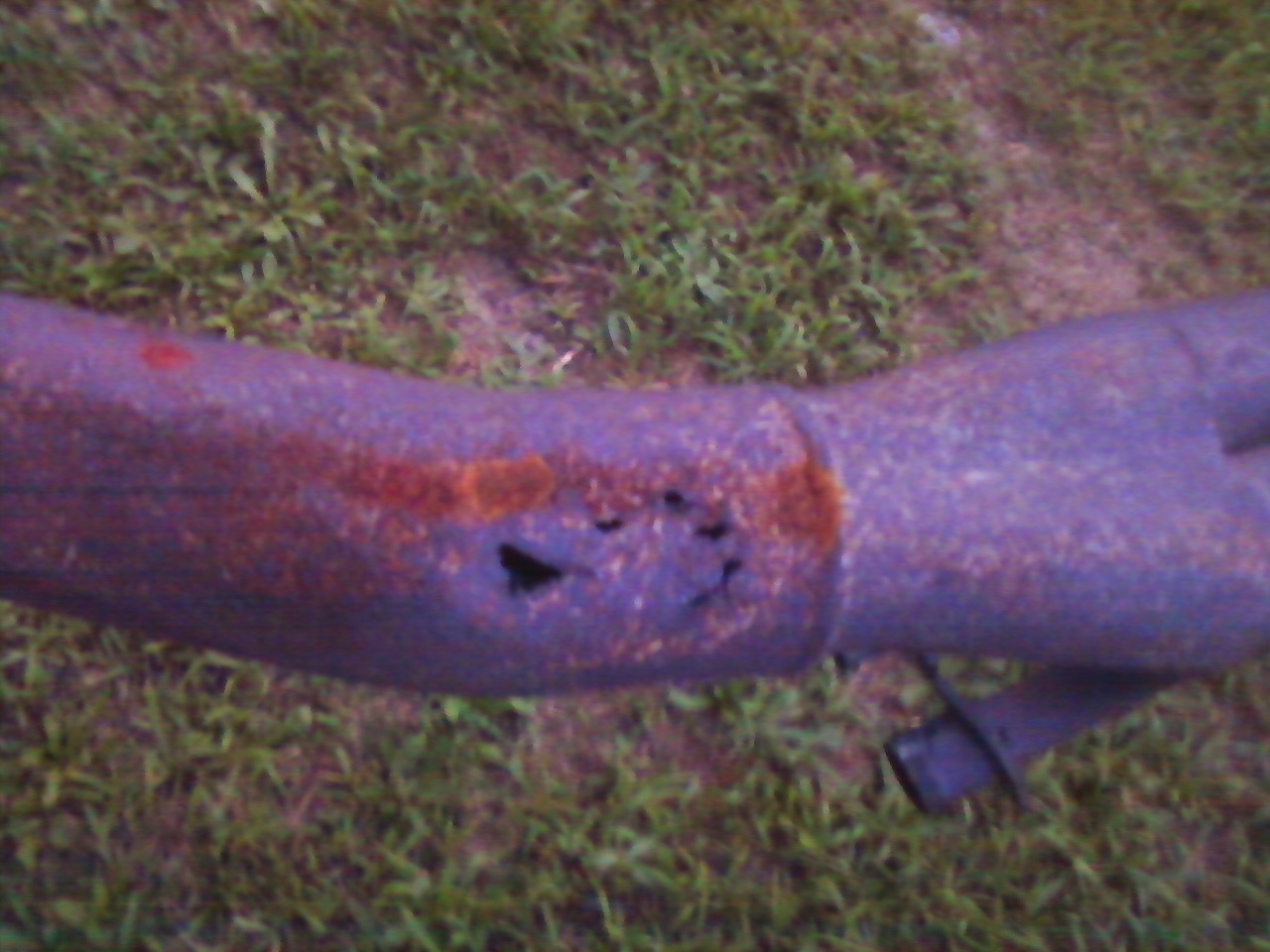
It is crazy but all of the preceding steps were necessary every time I wanted to change the oil filter, I loved the sound and performance of this system but due to the extra maintenance work and the damage it has suffered over the years (it was on the bike when my wife bought it for me) I decided to replace it.

Rusty pipe

Until next time,

Peace Y’all

Factory Punch Marks Another Random Tech Tip

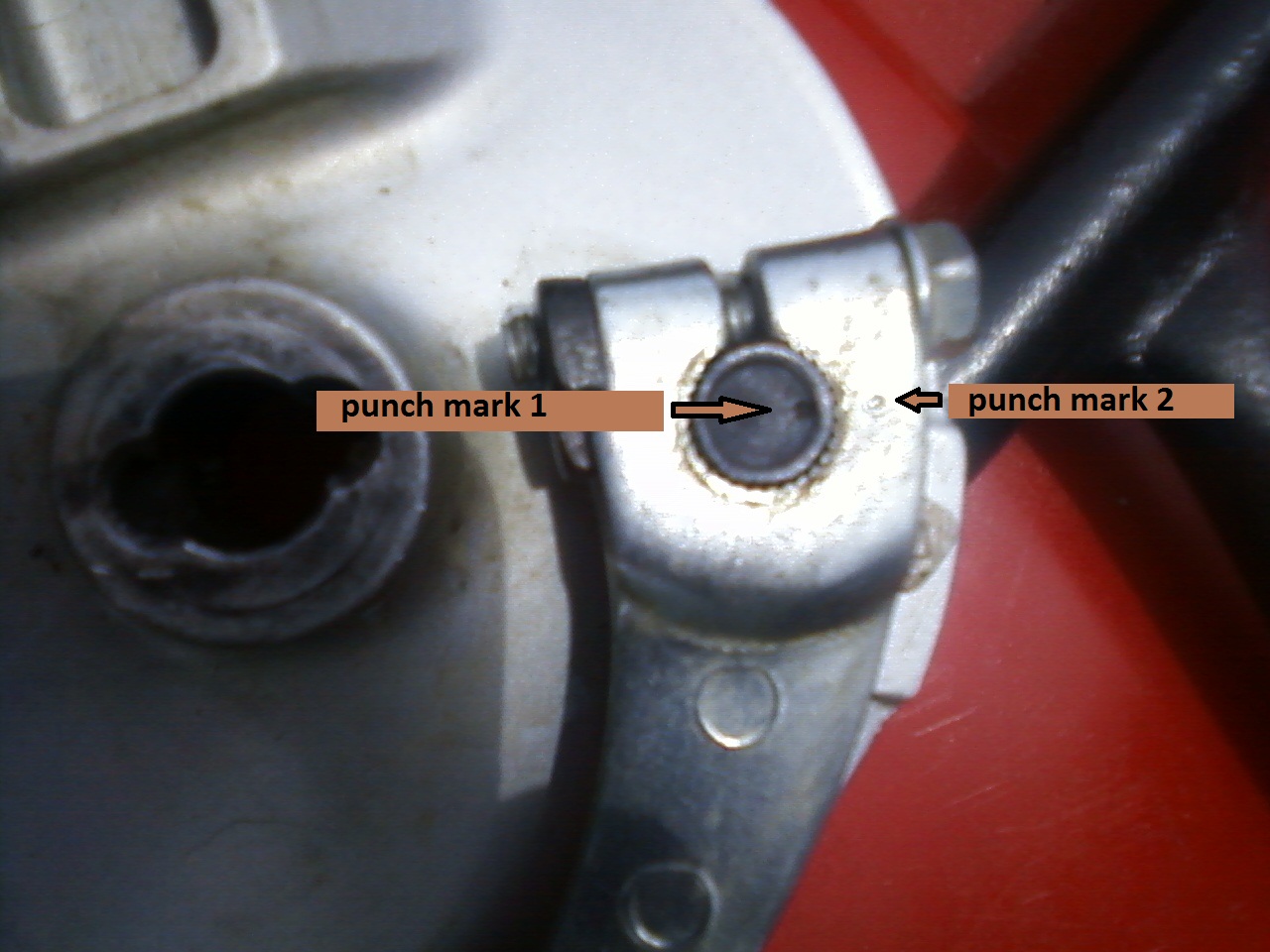
This tech tip is for all of the people who are just starting to wrench on their own motorcycles, although I have met a few old timers who may not know it. All of the big four makers do this on most of their machines. I don’t know about HD or the current European brands but all of the top Japanese motorcycle companies do it. They put punch marks on the various components that mount to shafts with splines. Shift lever, decompression levers, drum brake levers etc. almost always have punch marks indicating the correct  alignment of the part to the shaft. Here is an example below from a Honda drum brake.

So now you know one more thing to look for when you start to tear into your own machine, and should your atv or motorcycle not have punch marks like this you can always add them before taking it apart if you need to. After all anything that makes it easier to reassemble your parts and get your machine running in top form is a great thing.

Review of the Harbor Freight Motorcycle Lift Table

I’ve been wanting one of these for a long time. For years I used a wooden table or a chain hoist to lift motorcycles up for repairs when I just could not bear to get down on the floor to work on them. As I’ve gotten older the combination of a weaker back and a fatter wallet has made this purchase a lot easier to justify. So when the September issue of my favorite motorcycle magazine arrived on my Kindle with a coupon to purchase this lift for $299 I bought a print copy ASAP & clipped the coupon.

Ironically enough it took me 2 weeks to purchase this from either of the 2 nearby Harbor Freight stores. Unfortunately this led to my first real negative experience with a company that I have enjoyed doing business with for years. Last Saturday I went to my closest store in Florence S.C. and they were out of stock, so I called the store in Dillon an hour drive from here and they were also out, but told me they were expecting a shipment on Thursday. Yesterday, I was in Florence and they were still out, so I called the Dillon store and gave them the item number and was informed they had some in stock. So I gassed up my van and rolled up the interstate to that store, imagine my shock when I handed the clerk my coupon and was told that they were out of stock. When I mentioned that I had just called and had been informed that they were in stock. Then she went back to the computer and “found” one for me. Probably just a human error but if you are using a coupon to buy one I would verify stock in your nearest store before driving very far to pick one up. Don’t mention the coupon until you get there.

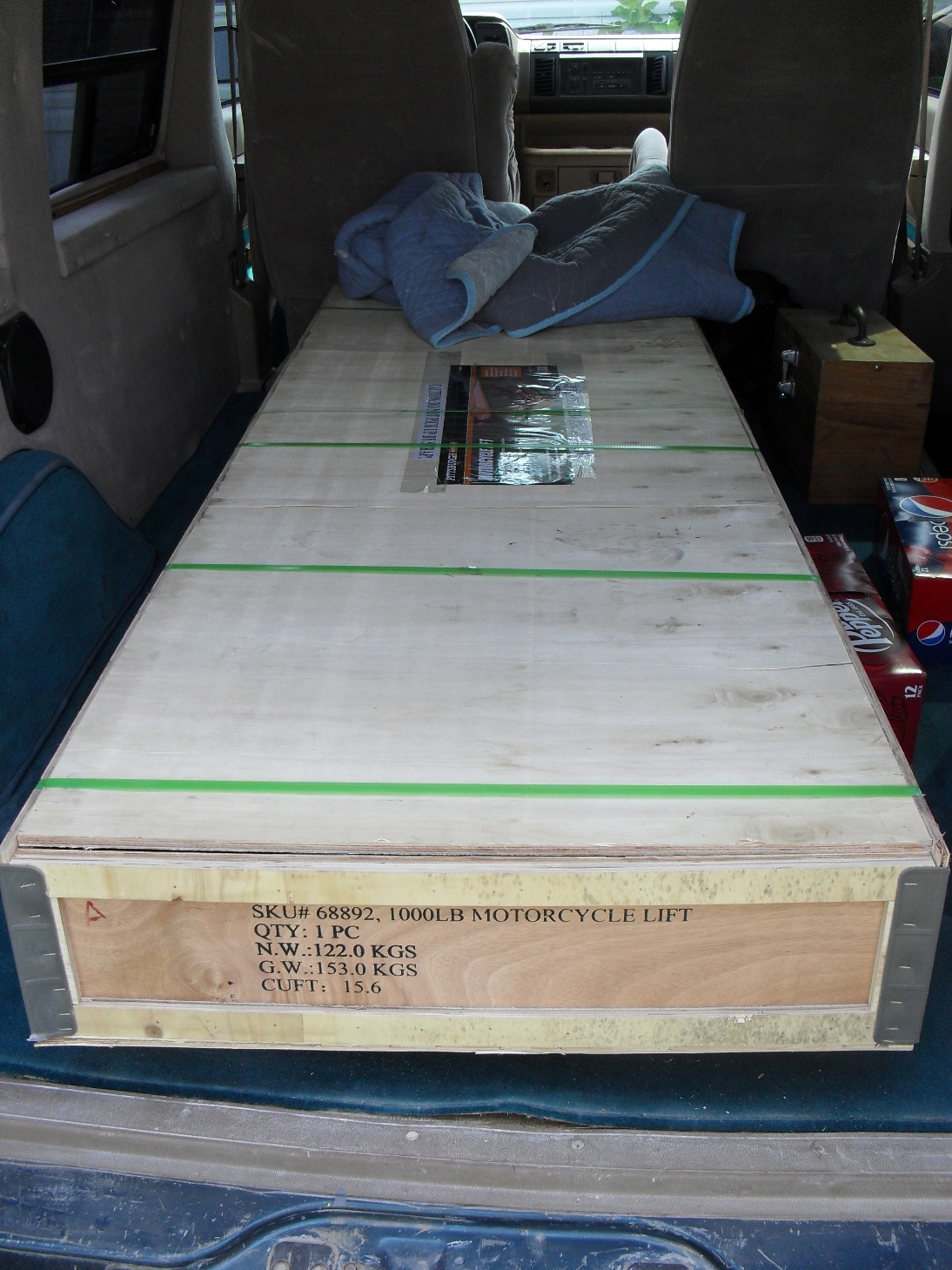
The shipping guys helped me load it in my van with the forklift. This worked out for me okay but if I had to do it again I would have taken a trailer for easier loading and unloading. If you have a long bed pickup truck that’s the best thing to use.

lift in crate in my Astro van

lift in crate in my Astro van

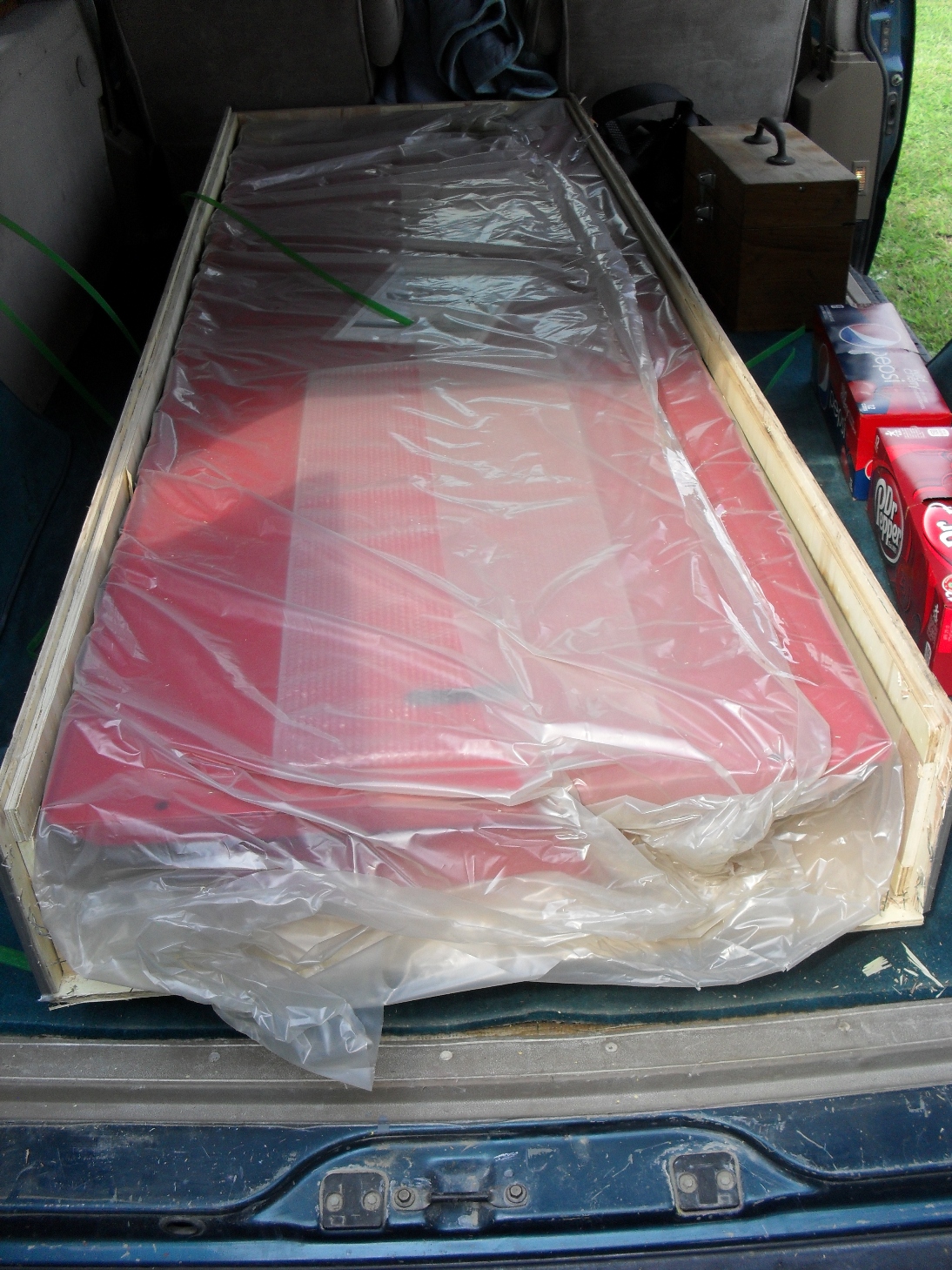
Since the completed crate was far too large and heavy for my beautiful assistant and I to remove from the van I simply opened where it was and slid the contents out into the door of my barn.

motorcycle lift crate open

motorcycle lift crate open

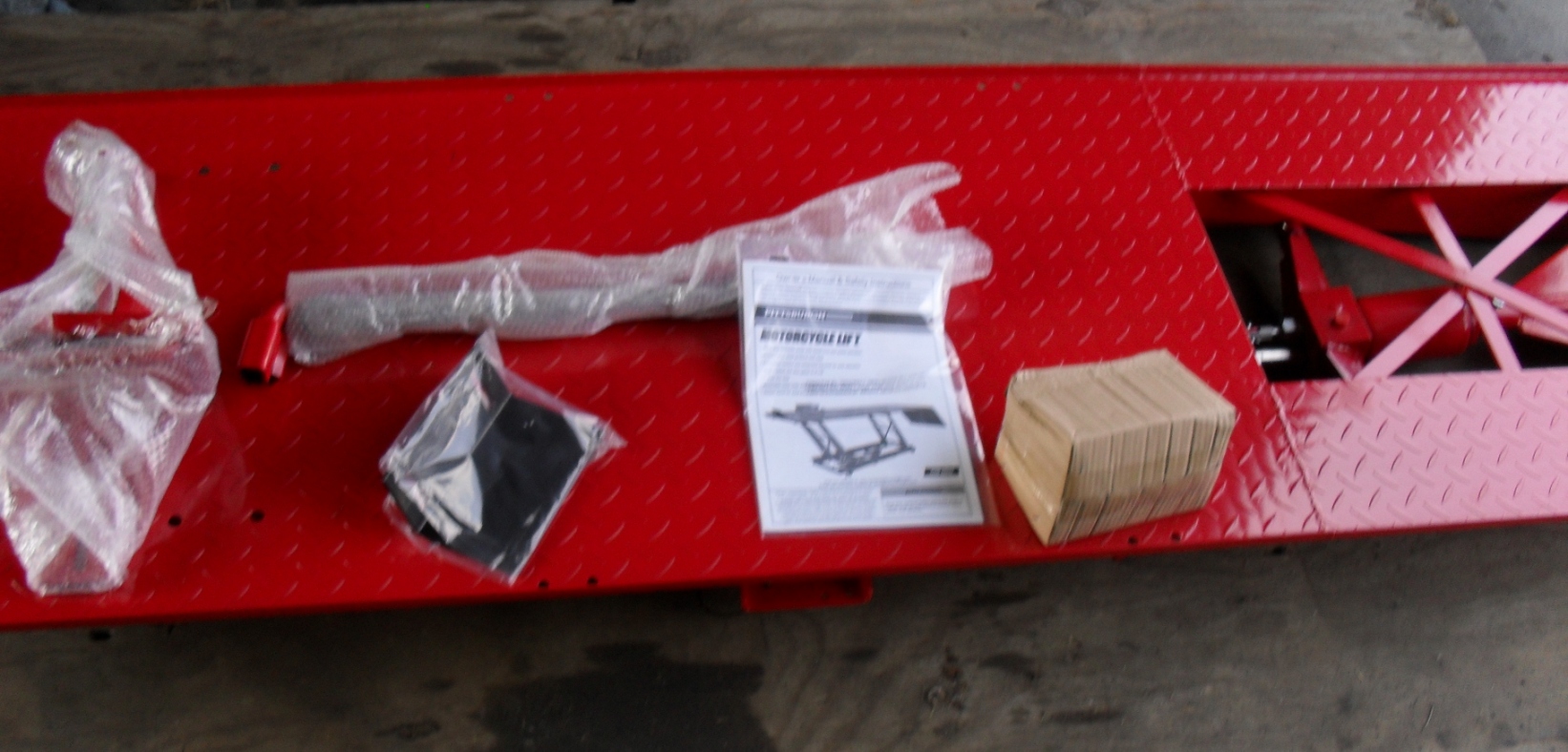
I am not going to do a step by step walk through of the assembly because in all honesty the instructions that come with it are perfectly adequate to help you get it together. I will touch on a couple of things that I think you should know about. First I got all of the parts laid out and read the instructions from beginning to end.

Harbor Freight Motorcycle Lift Table w/ parts & instructions

Harbor Freight Motorcycle Lift Table w/ parts & instructions

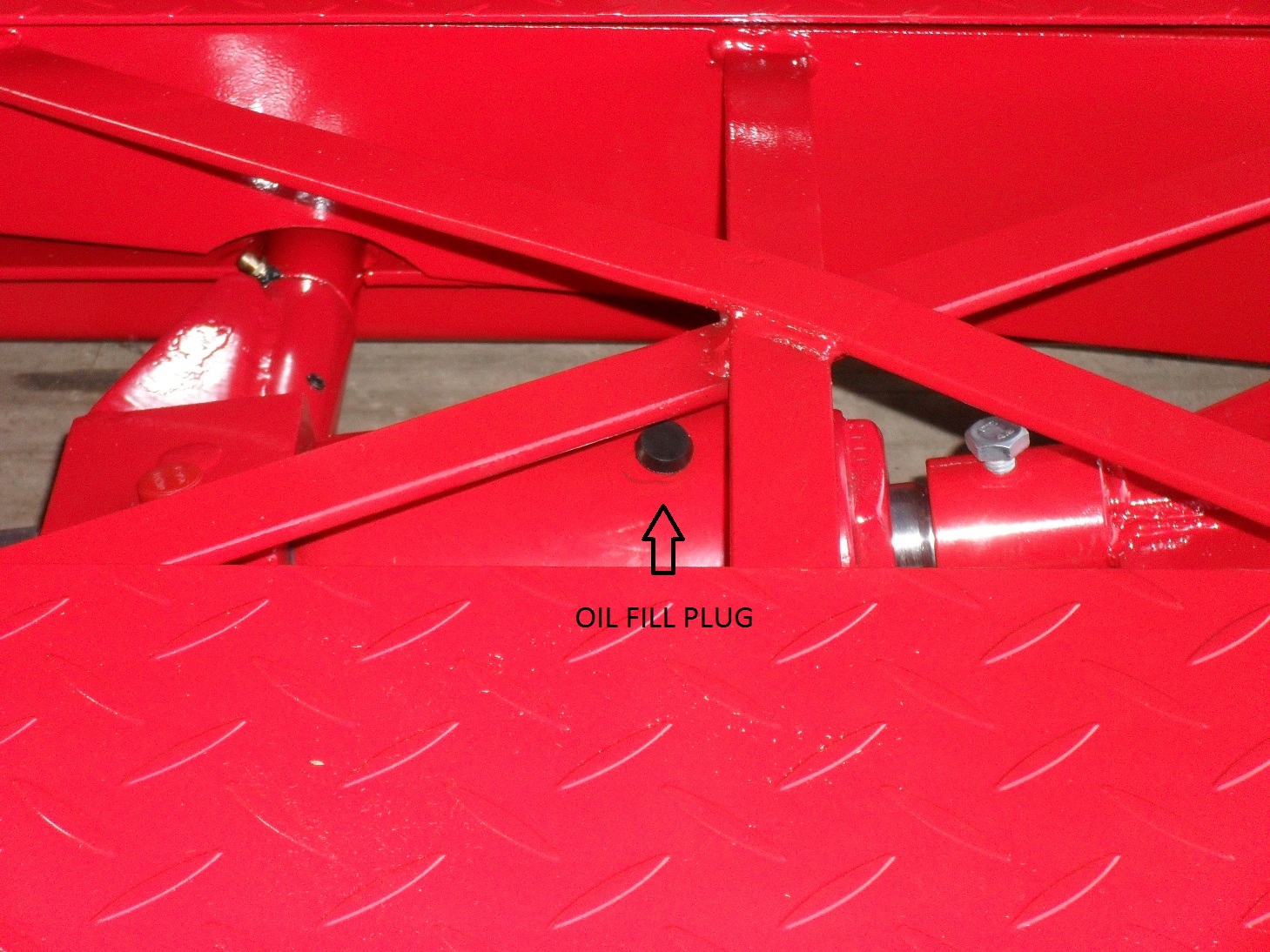
Harbor Freight Motorcycle Lift Table oil fill plug

Harbor Freight Motorcycle Lift Table oil fill plug

One of the things that you are instructed to do is to check the level of oil in the lift cylinder. The fill plug is in the location shown in the picture below.

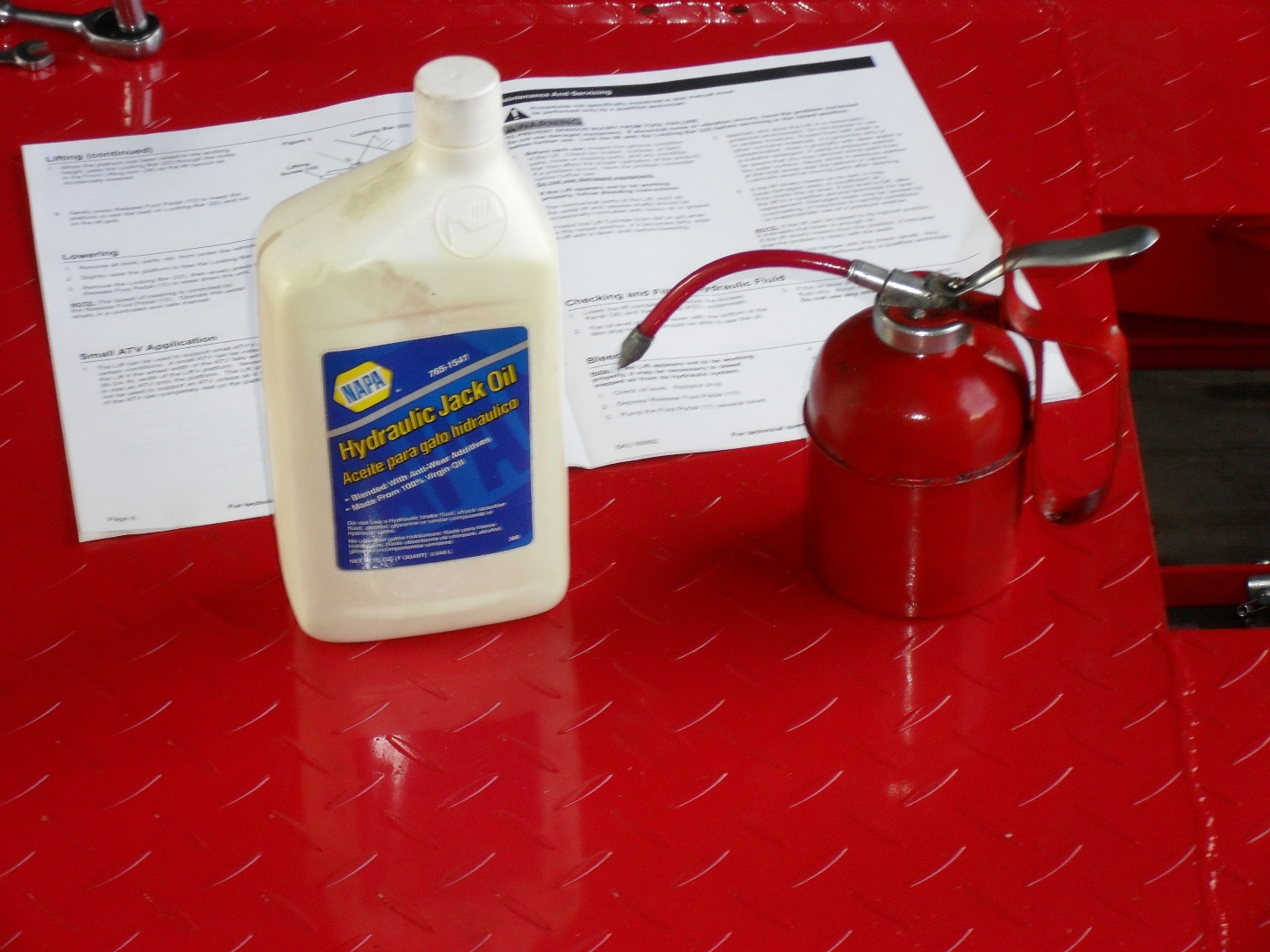
Be sure to use a decent grade of jack oil. If you do not have some at home go ahead and pick some up at Harbor Freight while you are there. The best way to fill a jack cylinder like this is with a squirt can. Mine turned out to need a pint of oil to fill it.

oil I used for my Harbor Freight Motorcycle Lift Table

oil I used for my Harbor Freight Motorcycle Lift Table

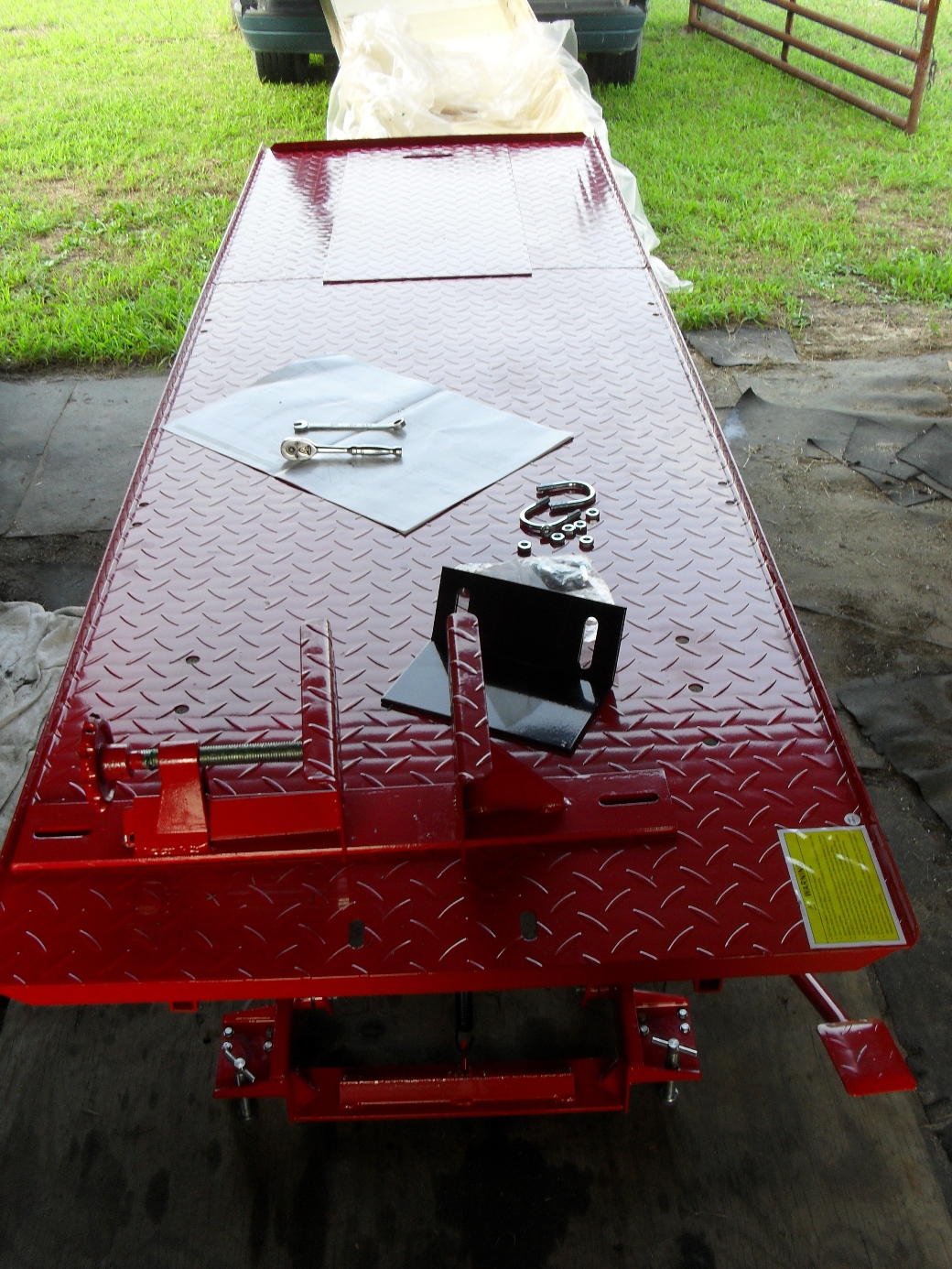
The instructions seem to want you to install all of the parts and accessories before you check the oil and raise the lift. I personally installed the wheels, then filled up the jack and raised the table all the way up to install the wheel vise, tie downs, & the ramp. You should do whatever seems safest to you.

Installing accessories on my Harbor Freight Motorcycle Lift Table

Installing accessories on my Harbor Freight Motorcycle Lift Table

Here it is altogether.

my fully assembled Harbor Freight Motorcycle Lift Table

my fully assembled Harbor Freight Motorcycle Lift Table

  After double checking the assembly of the table I lowered it back down and drove the Minimum Ninja up on it so that it could receive some long overdue TLC.

Look Y'all it's the Minimum Ninja!

Look Y’all it’s the Minimum Ninja!

Yesterday after strapping the bike down I raised the table to its maximum height and left the motorcycle sitting on it with the safety bar properly installed. When I went back this afternoon it was still all the way up. A lot of people criticize the design of the wheel vise but I think that it is okay. Unlike the larger vises I am certain that one can perform most fork and front wheel service without removing it. When I was a dealership mechanic most of the time the wheel vises from our heavy duty air lifts spent most of their time lying under the workbenches because they got in the way. Plus my bike still has a centerstand 🙂

Kawasaki Ninja 250 on my Harbor Freight Motorcycle Lift Table

Kawasaki Ninja 250 on my Harbor Freight Motorcycle Lift Table

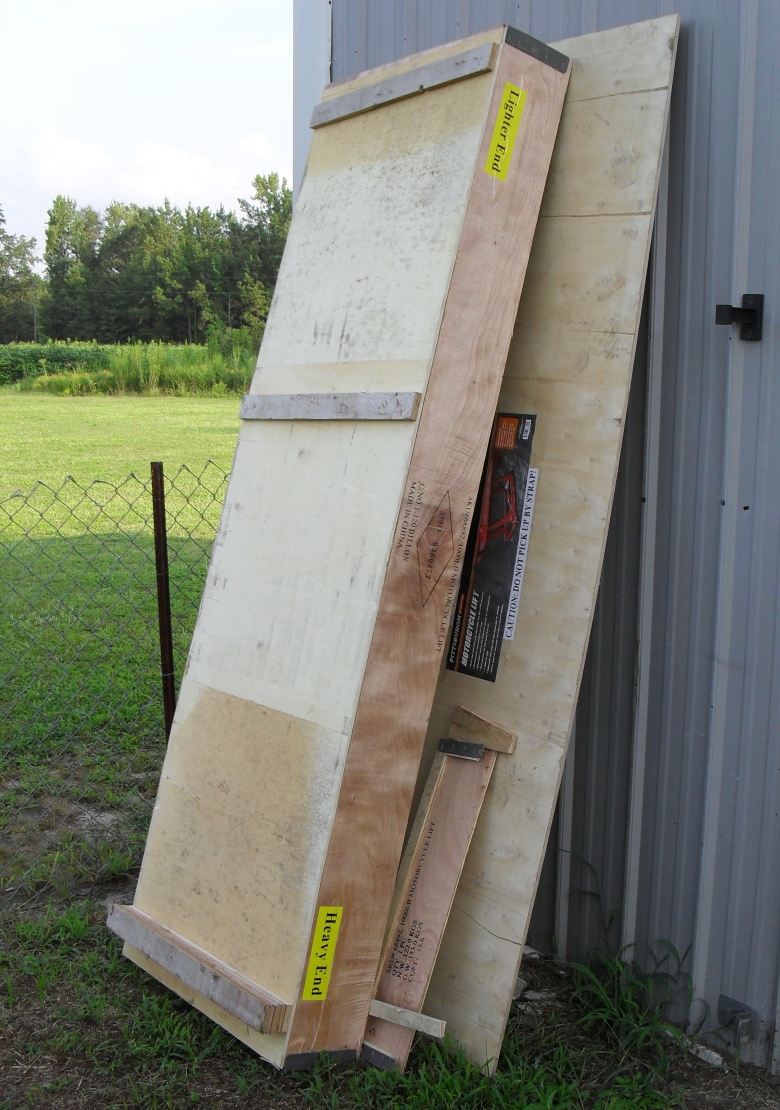
Don’t forget to recycle the crate! It actually has a couple of large pieces of usable plywood, I know that you can always find a use for a good piece of wood around the house or shop.

Recycle this crate you know you want to.

Recycle this crate you know you want to.

This will be a long term review. Over time I will publish new updates or simply update this post as I get some miles and years put on this thing.

As for the Minimum Ninja, it will receive its own pages here covering the updates and repairs as I make them.

Peace Y’all