The Fool Tank Chronicles : Part Two

One thing that I have discovered while working on this motorcycle is that deliberately building a rat bike is actually a lot harder than it would seem. In all honesty, a deliberately created rat bike should properly be called a neo-rat bike. A real rat bike is a natural creation, a collection of found art held together by grease, road grime & baling wire that accumulates over decades and tens of thousands of miles. People like my self who drag up old bikes & mechanically restore them while leaving the patina semi-intact are actually just posing. But what the heck it’s a lot of fun! Even so the siren song of the polishing machine, paint gun & steel wool are very hard to resist. Have you ever tried to clean just the inside of a dirty weather-beaten old engine cover and then tried to reinstall it so that it looked as if it had never been disturbed? It ain’t as easy as it sounds. Leave the chrome rusty, oh the horrors! Working hard on your sheet metal & then covering with flat or semi-gloss paint instead of making it shine like a brand new penny is very counter intuitive, but sometimes we really enjoy the results.

<drillium on a CB650>

Here’s some of that exotic metal called drillium.

Now let’s get back to my screwing up a perfectly good tank. As I mentioned in part one the original plan was to cut the rear subframe off and install a custom one for that straight framed 60s & 70s look. When that didn’t happen I took my cut down stock seat & had it recovered in black & green & fitted it to the bike & I actually did my shake down runs and a good bit of commuting on it as it was. Still every time I looked down & saw the bottom edge of the tank was nearly a half an inch above the nose of the seat it bugged me. You see even on a rat, craftsmanship counts. It’s one thing if it has dent’s, rust & flaking paint, but if you modify something or deliberately create a faux patina on something you must do it correctly. For example it’s okay to fog some flat black primer directly over a piece of rusty pitted metal but it is totally unacceptable to get a bunch of paint runs while doing so, because that smacks of sloppy craftsmanship. To me, being my own worst critic, that large seat to tank gap was a sign of very sloppy craftsmanship & it had to go. After experimenting with different thicknesses of rubber isolator for the rear mount I was able to reduce the gap down to about a quarter of an inch. Still too sloppy for me so I took a small body hammer & dolly & started rolling the rear seam of the tank down, figuring that I could repair the green portion of the paint by blending. I actually thought it was going to work but when I was almost finished the seam split. I probably could have silver soldered it closed & coated the tank with a sealer, but my boys kept insisting they did not want to chance a gasoline shower at 60 m.p.h. so it was off to ebay to find another tank.

Buying a gas tank for a motorcycle on ebay can be a very scary proposition. When I was rebuilding the Minimum Ninja, I bought three before I got one that was even usable. The sad part is that I had already left the sellers good feed back before discovering the problems. If I were doing a serious show quality restoration I would do my best to source a N.O.S. tank from a vintage parts dealer before buying one at an online auction. Since this was not a restoration I was hunting functional with a few light dings and no rusted out spots. The one I found looked alright, it had a few visible dings, & some rust on the inside but it was good & solid. I went ahead & put in the rear mounts so it would fit a CB650 this time paying very close attention to how it lined up with the front of the seat.
<bondo bucket gas tank>

arrrgh!

<CB750 to CB650C tank adapter>

<spot putty on top of the primer>

Putty smeared all over the tank & I still missed a couple of spots.

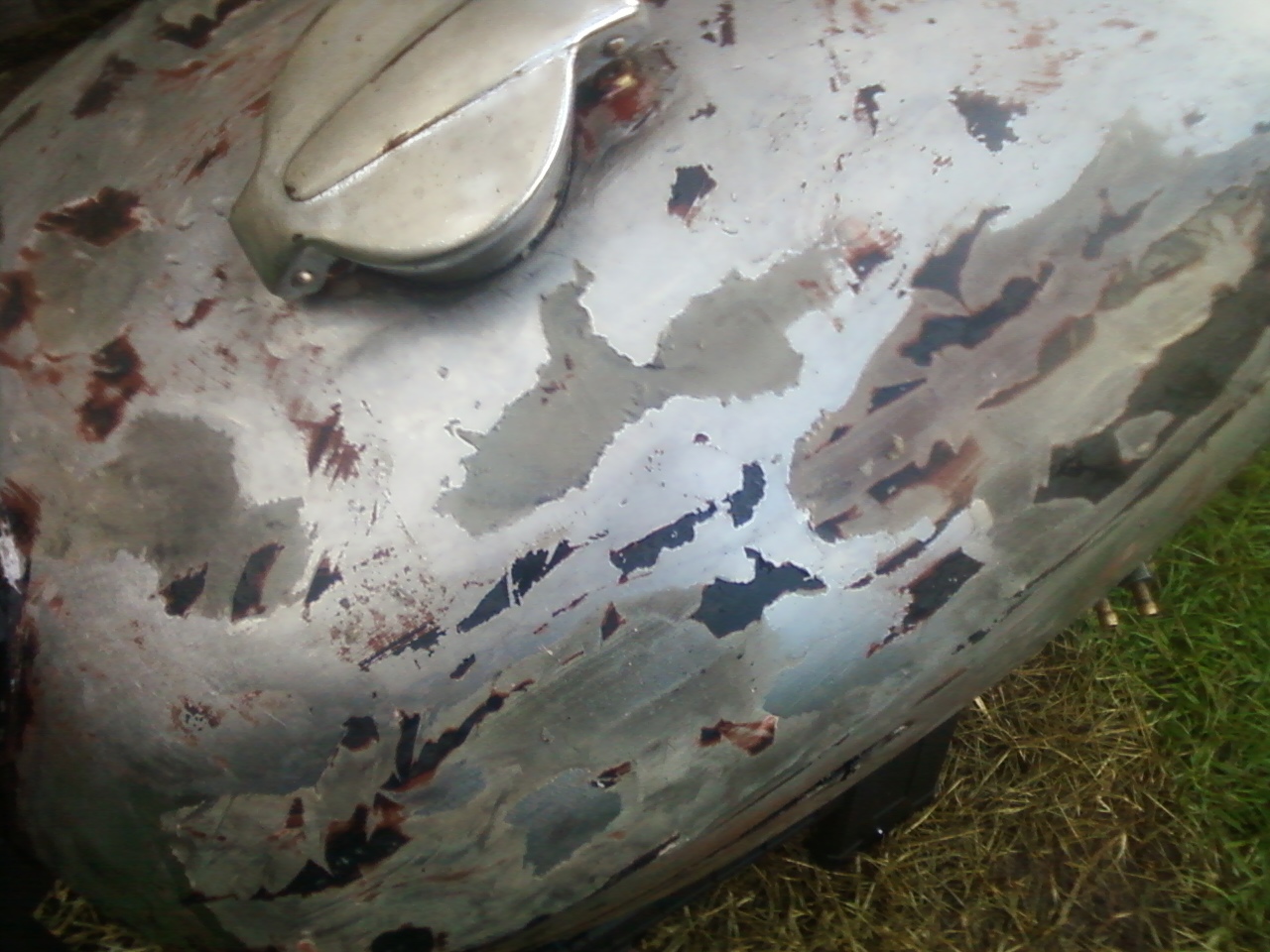
Since it was going to be acid washed & lined to keep the rust out of my gasoline, I decided to strip it down & fix the two or three visible dents on the exterior. Then I started removing the paint to fix dents only to find someone had already fixed a bunch of dents. There was already bondo everywhere! Discouraged I actually got back online & began looking for another tank. The problem is that I had already pre-registered for the Bull City Rumble this coming Saturday. So I just stayed up late last Friday night & fixed everything, acid washed it, put in the tank liner & had it ready to paint first thing Saturday morning.

<1970s Honda CB750 tank w black primer>

the black primer was actually kind of cool looking

Since I was doing all this extra work I wanted a nice durable semi-gloss dark green that was in line with my original vision for this bike. Being an old country boy I really like the Majic brand tractor & equipment enamel, it is a catalyzed enamel that although it has a long initial drying period becomes very durable. The downside is of course that you are limited to tractor & implement colors. But that was okay since I never found an off the shelf semi-gloss paint in the color I wanted anyway. instead I poured some John Deere green into a mixing cup & kept adding matte black until I got the shade & sheen that I wanted.

After seeing how it looked I decided not to put the stripes and the airbrushing back on it this time, in fact I even color matched the emblems before re-installing them late Sunday afternoon after giving the paint 24 hours to dry.

<a green Honda gas tank>

As I sit here writing this on Wednesday the Suburban Assault Scrambler is sitting in the carport, yesterday I put gas in it for the first time with the new tank, and rode it to work today. At lunch time I took a bunch of pictures of the finished product sitting in various industrial locations, but you’ll have to wait a couple of more days for those pics. Then I have to rest a little bit & get ready to start on the next project!

<suburban assault scrambler teaser>

Lining a Fuel Tank with Kreem Tank Liner

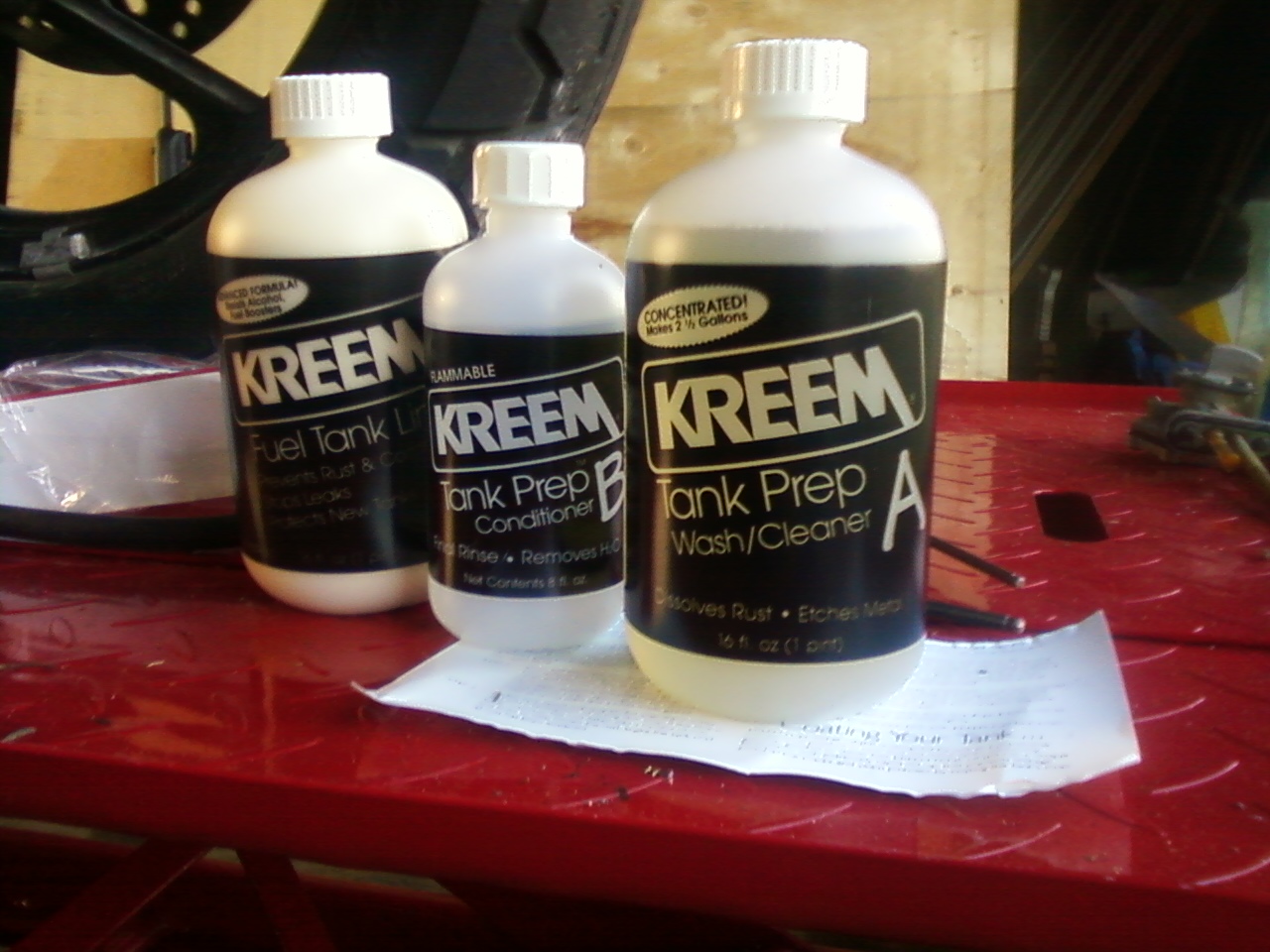
Kreem tank liner kit

Kreem tank liner kit

This is sort of a combo how to and product review. I will admit that my review is a little biased because I have been using this product for over 20 years and have always been satisfied with the results. I wont repeat the instructions word for word but I will give you a few tips to help you get better results. First empty your tank and remove the petcock and filler cap if it is bolted to the tank.

Remove the Kawasaki locking fuel cap

Remove the Ninja’s locking fuel cap

The next step is critical to getting good results especially if working with the tank from a 2 stroke engine. You must completely degrease the inside of the tank with a good industrial degreaser. Do not use dish liquid because it often contains oils to protect skin. Be prepared to wash it more than twice if needed to get the oil out.

Wash & degrease tank thougoughly

Wash & degrease tank thoroughly

Now open up the kit and get out the bottle labeled “A” wash & cleaner. Use duct tape or a blocking plate to block all of the holes in the bottom of your tank. I like to use a piece of metalized tape first and then cover it with duct tape.

Kreem Kit Part A

Kreem Kit Part A Use proper precautions for mild acid.

The instructions say to use warm water and I agree it does help the acid work much faster. Please note the standard kit shown here is for smaller tanks. Normally for a 5 gallon tank like this I would buy the larger size, but I had some left over from a previously restored tank, that I added in after using this up according to the instructions. The cleaner part A can be saved and re-used a time or two.

Warm water is reccomended to mix with cleaner

Warm water is recommended to mix with cleaner

After the tank is full seal off the top and let it sit for at least the minimum time given in the instructions. Since this was an old tank with some rust inside I let it sit overnight. At this stage some people will put in rocks or nuts & bolts and shake the tank to help remove thick rust. If you need to do this I recommend that you use steel nuts & bolts so that you can retrieve them easily with a magnet. Some fuel tank designs make it difficult to remove rocks after you are finished cleaning out the rust.

Next remove all tape from the openings rinse the tank well until the water comes out clean. and then thoroughly dry the tank on the inside. Since I had plenty of time I placed the tank in a hot sunny location to air dry. In the winter time or if you are in a hurry use a hair dryer or a hot air gun to speed up the process.

<ninja fuel tank drying in the sun>

fuel tank drying in the sun

I do need to warn you about one thing if you are trying to fix a tank with a nice paint job or if you are coating a new tank as a preventative measure you want to be very careful with this stuff, especially in the next two steps.

Seal up all the holes again and get out part “B” the conditioner. This bottle contains MEK which can remove paint faster than tequila removes panties. If you have a nice paint job & spill this on it, you wont have a nice paint job anymore, so be careful. I am re-painting this tank so I don’t really care if I spill some. After sealing the tank back up shake all around the inside of the tank & the carefully drain it out protecting your paint as needed.

Kreem Part B final rinse

This is highly flammable & can destroy paint so be careful.

Since the petcock on this one bolts into place before going to the next step I put two screws in the bolt holes to keep the threads clear. To me this is just much easier than cleaning out the holes afterward.

petcock screw holes

I like to put bolts in these holes to keep them clear

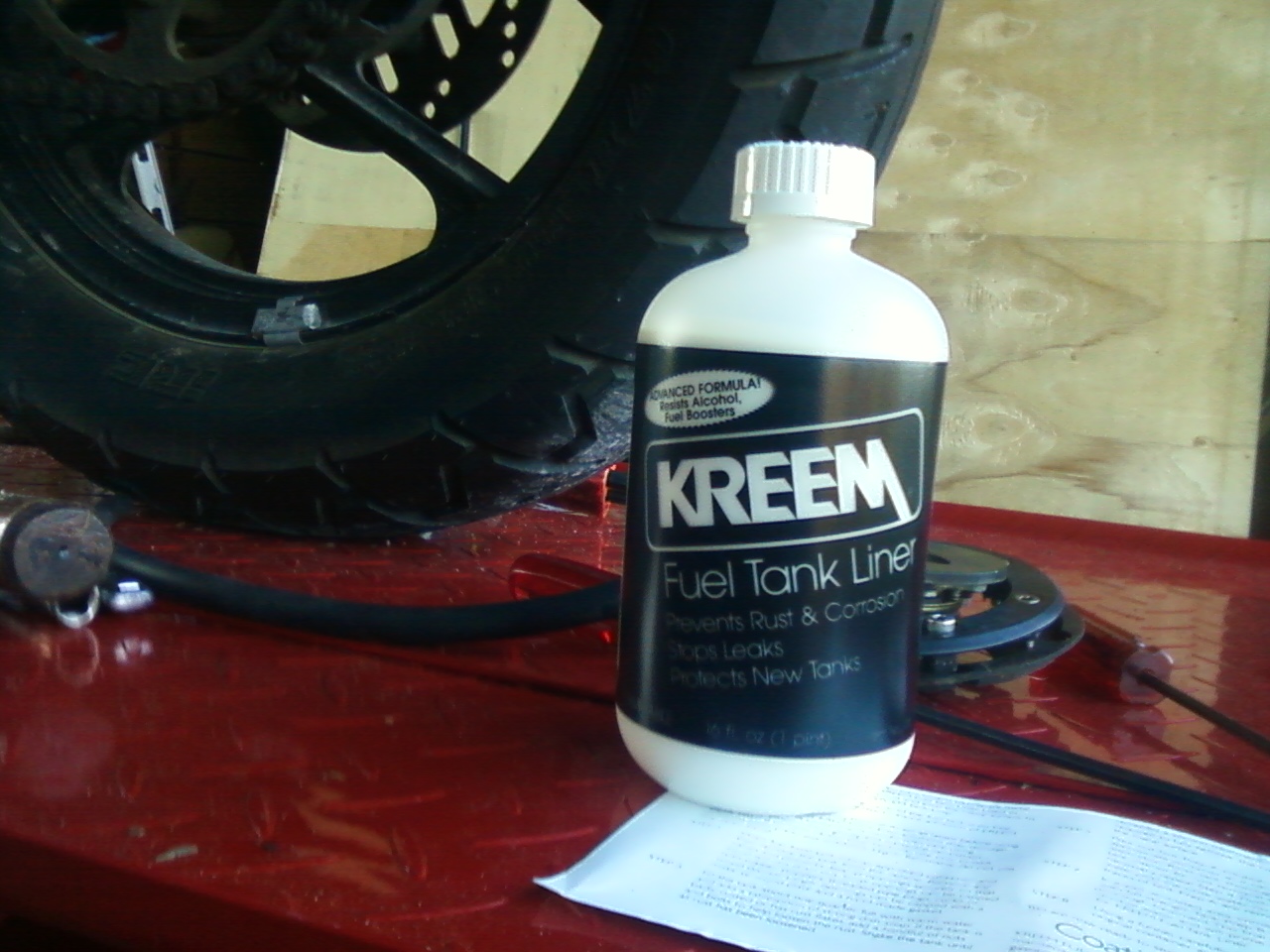
Now you are ready for the bottle of fuel tank liner. All the same warnings about paint damage apply to this bottle as well.

Kreem Part C liner

Kreem Part C liner

Here is a shot of how I use the metal tape first & then cover it with duct tape to seal the openings in the tank. It works well for me, but I make no garuntee that it will work this well for everyone.

<handymans best friend>

Red Green is absolutely right about this stuff! (Duct tape that is)

Then pour in the whole bottle of liner, and then seal up the filler hole as I did in the next picture.

pour in Kreem Tank Liner

pour in Kreem Tank Liner

then seal up the filler hole

then seal up the filler hole with duct tape

Then spend the next 30 minutes or so slowly rotating the tank end over end and sideways until you are 100% certain that the entire inside of the tank has been covered with sealant. Next (and this is very important) open the tank back up and drain the excess sealant back into its original bottle. Do not leave it in the tank as it will greatly increase drying time. If too thick it may skin over on the top and take nearly forever to dry all the way through, causing you to have problems later. I usually save the excess to use on the next project. I am usually able to do a lawnmower tank or two with the leftovers.

Like I said if you follow the instructions in the kit and the hints that I gave here you should be able to tackle this job yourself at home. Just give yourself a couple of days if your tank is rusty, and be sure you drain the excess sealant out of the tank and give it time to dry really well. This stuff aint cheap at approximately $50 a pop (November 2012 price) so you want it to work right the first time. I have used other tank sealers with varying degrees of success, but I always come back to the original Kreem brand. Plus it is usually in stock on the shelves in most motorcycle dealerships. Besides have you priced a new gas tank lately? It’ll give you a coronary!

Peace Y’all